
A diesel generator set weight is the sum of five masses: engine, alternator, skid and tank, canopy, and fluids. Check each of them before you book freight.
Key takeaways
A diesel generator set weighs 1.1 to 1.5 times its dry figure once coolant, oil and fuel are aboard, and an acoustic canopy can add 30% by itself. The gap matters at the quay: a set leaving the works at 4,053 kg reaches the ship at about 4,650 kg.
- Export quotations from Tesla Power start from the wet weight plus fuel, not the catalogue figure.
- Dry weight leaves out coolant, oil and fuel; that gap is 216 kg on a Cummins C1000 D5.
- Enclosed sets of the same rating run 30% to 45% heavier than open sets.
- A 40ft high cube carries 28,600 kg of payload, so two 17,147 kg sets cannot travel together.
- Weight sets crane capacity, floor loading and lashing counts, not only the freight bill. Our generator installation and sizing notes cover the rest of the shipping envelope.
Table of contents
- What five masses make up a diesel generator set weight?
- Which component dominates the total?
- How does weight scale with rating?
- Worked example: a 500 kVA set from dry weight to shipping weight
- Why the data sheet weight is not the shipping weight
- How do you confirm weight before you book freight?
- Lifting points, floor loading and foundations
- Frequently asked questions
What five masses make up a diesel generator set weight?
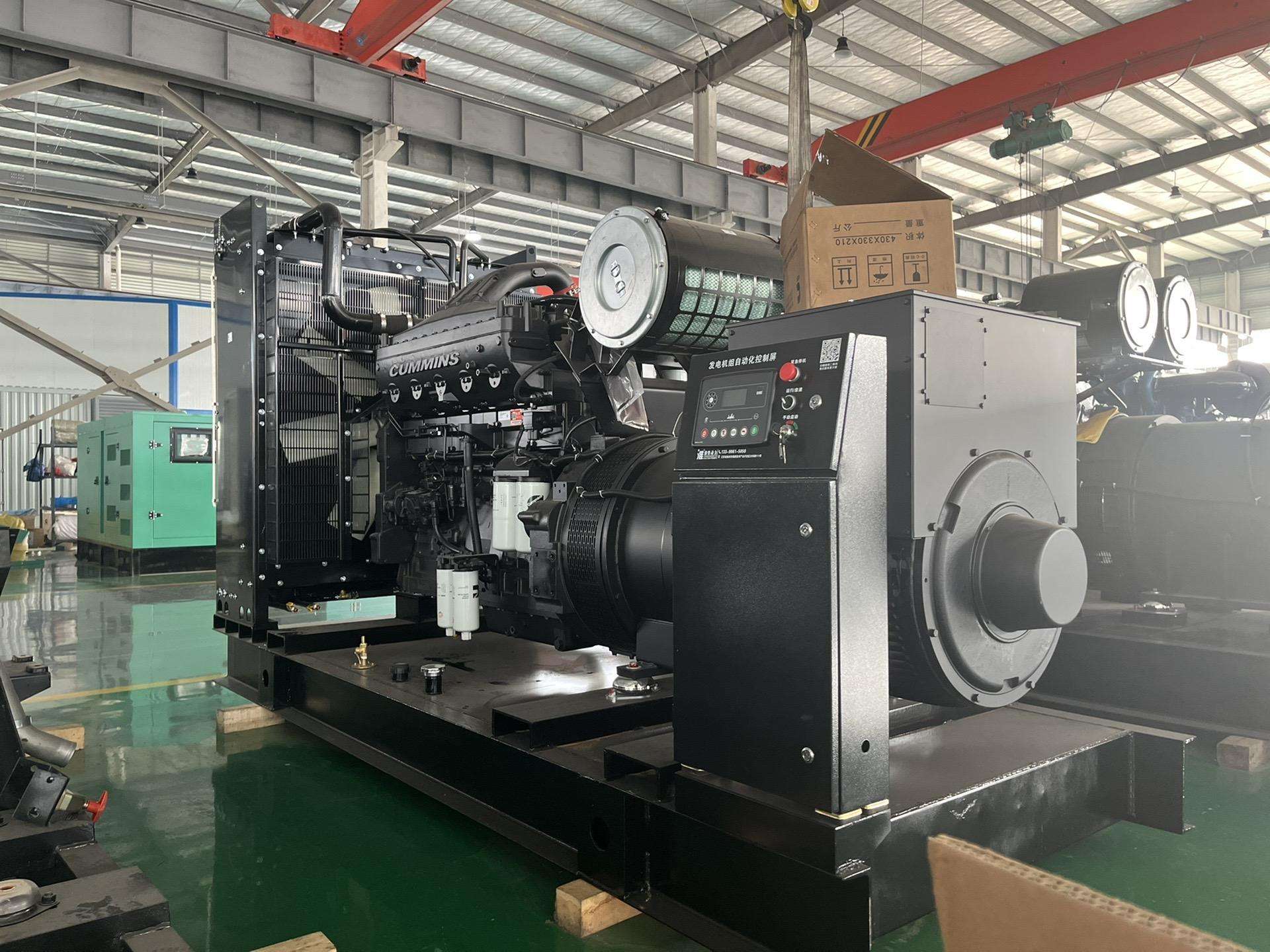
A diesel generator set weight is five masses stacked on one base frame: the engine with its cooling package, the alternator, the skid with its fuel tank, the canopy when one is fitted, and the fluids that fill all of them. On the Cummins C500 D5 those five lines add up to 4,053 kg wet, and each one is printed separately on the data sheet. The engine and radiator assembly is the densest item and sits at one end of the steel skid. The alternator is a solid mass of laminated steel and copper at the other end, and its weight tracks output more closely than the engine does. The base frame carries both, often doubles as a day tank, and adds the lifting points that decide how the set leaves the factory.
A canopy is a steel box with louvres, doors and acoustic lining, bolted around the set rather than replacing anything, so it is pure addition. Fluids are the smallest line and the most often forgotten: coolant, lube oil and the fuel in the base tank all travel with a commissioned set and all count on the bill of lading. Tesla Power Equipment lists these five lines separately on every quotation, so the buyer can see which line moved when a total changes.
Which component dominates the total?
The engine and alternator together account for the majority of a diesel generator set weight, but the canopy is the largest single add-on a buyer chooses. On the Cummins C500 D5, the open set weighs 4,053 kg wet while the enclosed version weighs 5,281 kg, a difference of 1,228 kg, or 30% of the open figure, according to the manufacturer data sheet. That 30% buys the enclosure options for a diesel generator set that keep a set quiet and weatherproof, and it also changes everything downstream. A 1,228 kg increase lifts the crane class, pushes the set closer to a container payload limit and raises the point load on the floor. The same pattern repeats across the range: the C275 D5 grows from 3,357 kg to 4,611 kg enclosed, and the C550 D5 from 4,239 kg to 5,558 kg.
How does weight scale with rating?
Weight rises faster than rating at the top of the range, because a larger set needs a heavier block, a bigger alternator and a stiffer skid rather than a proportionally thicker one. Across the Cummins C-series data sheets below, the wet weight of an open set climbs from 1,574 kg to 17,147 kg while the canopy penalty stays between 30% and 45% of the open figure.
| Model | Wet weight, open set (kg) | Wet weight, enclosed set (kg) | Canopy adds (kg) |
|---|---|---|---|
| Cummins C110 D5 | 1,574 | 2,274 | 700 |
| Cummins C150 D5 | 1,650 | 2,400 | 750 |
| Cummins C275 D5 | 3,357 | 4,611 | 1,254 |
| Cummins C500 D5 | 4,053 | 5,281 | 1,228 |
| Cummins C550 D5 | 4,239 | 5,558 | 1,319 |
| Cummins C1000 D5 | 6,520 | Not published | Not published |
| Cummins C1400 D5 | 10,069 | Not published | Not published |
| Cummins C2000 D5 | 17,147 | 15,780 with remote radiator | Not comparable |
Two rows need a caveat. The C2000 D5 is heavier with its own radiator mounted on the set than with a remote cooling package, the opposite of the pattern above, so cooling must be fixed before the weight is quoted. Tesla Power verifies the enclosed figure against the build sheet for every order, and an enclosed build such as the 700 kW open-frame and container set carries both figures on one page. The C1000 D5 and C1400 D5 data sheets leave the enclosed column blank, so an enclosed weight for those models cannot be inferred and must be requested.
Worked example: a 500 kVA set from dry weight to shipping weight
Take a 500 kVA set running at 0.8 pf (power factor), which is 400 kW of real output, and price the freight from its wet weight plus fuel. The Cummins C500 D5 open set is 4,053 kg wet on the C500 D5 data sheet. A 500 L base tank filled with diesel at 0.84 kg/L adds 420 kg, because EN 590 sets the density of automotive diesel between 820 and 845 kg/m³ at 15 °C. Packing and dunnage add roughly 180 kg, so the figure that goes on the booking is about 4,653 kg.
The 4,653 kg figure then has to be tested against the box. A 40ft high cube has a maximum payload of 28,600 kg and a maximum gross weight of 32,500 kg per published carrier specifications, so a 4,653 kg set uses 16% of the payload and the limit is never the weight. It is the footprint, the centre of gravity and the number of lashing points that decide the stow. Run the same arithmetic at the top of the range: two C2000 D5 sets at 17,147 kg come to 34,294 kg, which is 5,694 kg above the payload limit, so one set per 40ft high cube is the maximum. Tesla Power plans a stow from that ceiling backwards. The same stow arithmetic applies to every size below that ceiling.
Why the data sheet weight is not the shipping weight
A data sheet weight is a factory figure for a bare set, and a shipping weight is what the crane actually lifts. The difference is fluids, packaging and revision. The Cummins C1000 D5 shows it plainly: 6,304 kg dry against 6,520 kg wet, a 216 kg gap that is only coolant and lube oil and does not yet include fuel.
Revision drift is the second trap. Two published versions of the same C1000 D5 data sheet give dry weights of 6,304 kg and 6,246 kg, a 58 kg spread, and wet weights of 6,520 kg and 6,426 kg. Neither is wrong; they are different issues of the same document. A freight booking built on a remembered figure rather than the current data sheet can therefore be out by more than a hundred kilos before a single litre of fuel is added.
What else travels with the set?
Loose items travel too, and they are rarely on the data sheet: the exhaust silencer and pipework, the starting batteries, the remote radiator package when one is specified, and the spares box. Each is small against 4 tonnes and each counts against the payload and the lashing plan. Tesla Power adds a line for every loose item to the lifting and packing checks for a generator set, so the shipping weight is a sum of declared masses rather than an estimate.
How do you confirm weight before you book freight?
Confirm weight in four steps: read the current data sheet, add fluids and fuel, add packing, then test the total against the container payload and the crane chart. Anything short of that sequence leaves a number someone else has to guess at the quay.
Step one. Ask for the data sheet revision and the model code, not a class figure. A C500 D5 and a C550 D5 differ by 186 kg wet, and neither can stand in for the other in a lift plan.
Step two. Add coolant, oil and fuel to the wet figure, then state the tank volume you are filling. Fuel is the only line that changes with the order, and it is the line buyers most often leave at zero. Tesla Power supplies sets that ship in their own weatherproof canopy, such as the 500 kW set in a container canopy, and that envelope carries the filled volume, so the weight goes on the booking slip beside the tank size.
Step three. Add packing, dunnage and loose items, then compare the total with the crane chart and the container payload. On a heavy set the choice of box matters as much as the weight itself, because an open set of the same mass needs a dry box, a spreader beam and a lashing plan of its own.
Step four. Compare the total with the payload and with the lifting gear. A 40ft standard box carries 28,750 kg of payload against a door opening 2,274 mm high, while the high cube carries 28,600 kg with a 2,577 mm door, so the taller box trades 150 kg of payload for 304 mm of height. When the set is wider than 2,340 mm or taller than that door, a flat rack or an open-top box takes over and the lashing plan changes with it.
Lifting points, floor loading and foundations
Floor loading is a weight question that a freight quote never answers. A C2000 D5 with its set-mounted radiator occupies 6,175 mm by 2,286 mm, which is 14.1 m², and carries 17,147 kg across that area, so the slab sees about 1,215 kg/m². That is the number to put in front of a structural engineer, and it is a different number from the crane load. Lifting is the other half: each lashing eye on a flat rack is rated at 5,000 kg, and the maximum securing load of any lashing is 50% of its breaking load, per the Maersk lashing guide. A 17,147 kg set therefore needs at least four points sharing the load with margin to spare, and a four-point lift on a spreader beam is the normal arrangement rather than a nicety. Where a set will not pass a container door at all, the flat rack options for an oversize generator set set both the weight limit and the lashing plan.

Prepared by the export engineering desk at Yangzhou Tesla Power Equipment Co., Ltd., which builds diesel generator sets from 25 kVA to 1750 kVA and lists the largest single set on its build sheet at 1400 kW, that is 1750 kVA at 0.8 pf.
Frequently asked questions
How much does a diesel generator set weigh per kVA?
Roughly 14 kg per kVA for an open set at the small end of the range, easing to about 8 kg per kVA on the largest sets and rising again with a canopy. The Cummins C110 D5 open set is 1,574 kg at 110 kVA, while the C1400 D5 open set is 10,069 kg at 1250 kVA. Use the model data sheet rather than the ratio, because cooling arrangement and alternator choice move the figure.
Is the dry weight or the wet weight used for shipping?
The wet weight plus fuel is the correct shipping figure. Dry weight excludes coolant and lube oil, which on a C1000 D5 is 216 kg, and it excludes the fuel in the base tank entirely. A forwarder quoting from dry weight will understate the load, and the shortfall appears on the crane ticket rather than on the freight invoice.
How much does a sound-attenuated canopy add?
Between 30% and 45% of the open set weight on the Cummins C-series data sheets. The C500 D5 gains 1,228 kg and the C550 D5 gains 1,319 kg when enclosed. Above roughly 1000 kVA, several manufacturers do not publish an enclosed weight at all, so the figure has to be requested for the specific build rather than read from a table.
Can two large sets share one 40ft container?
Only when both fit under 28,600 kg of payload and inside 12,032 mm of internal length. Two C2000 D5 sets at 17,147 kg each come to 34,294 kg, so they cannot. Two C1000 D5 sets at 6,520 kg come to 13,040 kg and fit comfortably on weight, which leaves length, lashing and floor loading as the deciding factors.
What floor loading does a large set impose?
Divide the wet weight by the footprint. A C2000 D5 at 17,147 kg over 14.1 m² gives about 1,215 kg/m², and the point loads under the skid rails are higher than that average. Give both figures to the structural engineer, because a slab rated for a uniform load is not automatically rated for two concentrated rails.
Does altitude or ambient temperature change the weight?
Not the mass, but it changes the rating that mass has to deliver. A derated set produces less output at the same weight, and a remotely cooled package can weigh less than a set-mounted radiator while needing its own pipework and support. Fix the cooling arrangement first, then compare weights between two quotations on equal terms.
Next step: pin the number down before the quote
Weight is one of the few specification lines a buyer can close without technical judgement: read the model’s current data sheet, add the fluids and fuel you will actually carry, add the packing, then test the total against the box and the crane. Do that before the quotation is issued and the freight, the foundation and the lift plan all follow from one agreed figure. Send your load list and destination port to the Tesla Power export team through the send us your generator set load list, and the reply will carry the wet weight, the packing weight and the container plan together, so nothing is left for the quay to discover.