
When your business loses power, every minute costs money. Whether you’re running a hospital, data center, manufacturing facility, or construction site, the right diesel generator can mean the difference between business continuity and catastrophic downtime. But walk into the market today, and you’ll face dozens of models with confusing specs, competing claims, and price tags that vary wildly.
What buyers should confirm first
What Should You Consider When Choosing a Diesel Generator Set for Your Business? should be evaluated against the real load profile, voltage and frequency standard, duty rating, enclosure requirement, and installation environment before the order is confirmed.
Before requesting a quotation
- Confirm standby or prime duty and the expected running hours.
- Match site voltage, phase, and 50Hz or 60Hz requirement with the destination equipment.
- Check whether ATS, canopy, fuel tank, trailer, or remote monitoring are part of the same quote.
- Ask for the exact engine model, alternator model, controller type, and factory test scope.
Documents worth requesting
- Rated power table with standby and prime values clearly separated.
- Dimension and weight information for shipping, foundation, and room layout checks.
- Wiring diagram or ATS scope when the package includes switching equipment.
- Factory test record, packing list, and after-sales contact route for export support.
Related product resources
Choosing a diesel generator set isn’t about picking the biggest unit or the cheapest option—it’s about matching your actual power needs with the right equipment, duty rating, and support infrastructure. Get it wrong, and you’ll either overpay for capacity you’ll never use or, worse, discover your undersized unit can’t handle your critical loads when you need it most.
This guide walks you through everything you need to know: from understanding what power ratings actually mean to calculating fuel costs, navigating EPA compliance, and knowing which questions to ask before signing a purchase order. Whether you’re evaluating your first backup power system or replacing aging equipment, you’ll learn how to make a confident, cost-effective decision that protects your operation for years to come.
Understanding Diesel Generator Components: What You’re Actually Buying
Before you compare models, you need to understand what a diesel generator set (often shortened to “genset”) actually is. It’s not just an engine with a power outlet—it’s an integrated system where every component affects performance, reliability, and total cost of ownership.
The Core Systems
The Diesel Engine: This is your prime mover, converting fuel into mechanical energy through compression ignition. Unlike gasoline engines, diesel engines don’t use spark plugs; they ignite fuel through heat generated by compressing air. This design makes them more fuel efficient and durable for long-run applications, which is why you’ll rarely see a large commercial genset powered by gas.
The Alternator (Generator Head): The engine spins this component to produce electrical power. The alternator’s design determines your voltage output, kVA rating, and how well the unit handles sudden load changes (like when heavy equipment starts up). Quality alternators from manufacturers like Tesla Power use advanced voltage regulation to deliver clean, stable power that protects sensitive electronics.
Fuel System: Includes the tank, fuel lines, filters, and injectors. Fuel capacity directly affects runtime—a critical spec if you’re in an area with extended outages. Most modern units require ultra-low sulfur diesel (ULSD) to meet emissions standards.
Cooling System: Diesel engines generate tremendous heat. The cooling system (radiator, coolant, fans) keeps operating temperatures safe. Undersized cooling is a common failure point in hot climates or poorly ventilated installations, so pay attention to the manufacturer’s ambient temperature rating.
Control Panel: Your command center. Basic panels show voltage, frequency, and engine parameters. Advanced controllers offer remote monitoring, automatic start/stop, load management, and diagnostic alerts. If you’re managing multiple sites or critical infrastructure, the controller investment pays for itself in reduced downtime.
Enclosure or Frame: Portable diesel generators often come in weather-resistant enclosures that also reduce noise. Stationary units might be open-frame (installed in a dedicated room) or enclosed. Sound-attenuated enclosures are essential for installations near offices or residential areas.
When a salesperson quotes you a price, they’re pricing this entire integrated package. A cheap unit often means corners cut on the alternator, controller, or cooling system—components you’ll pay for later through failures or poor performance.
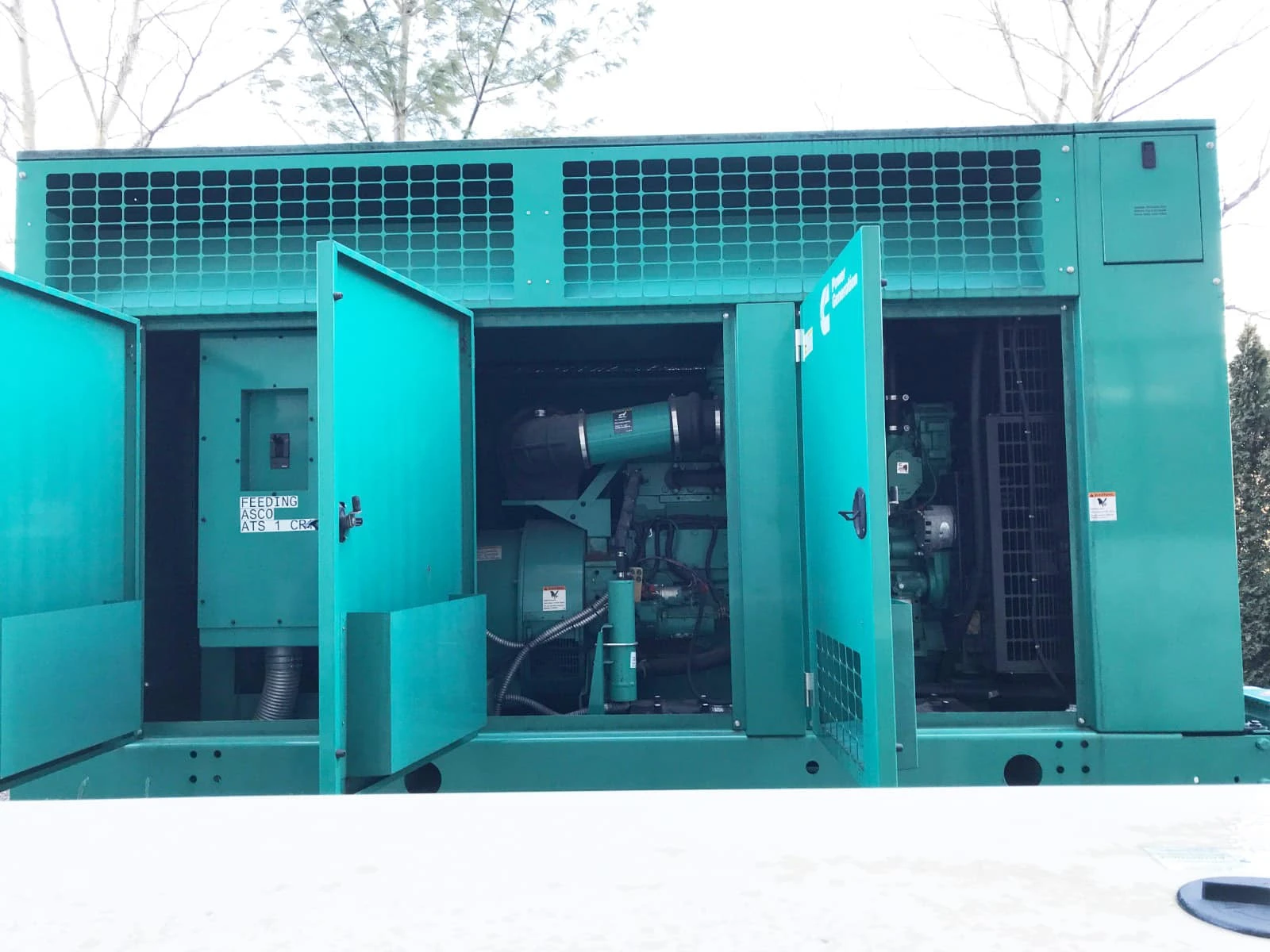
Figure 1: Modern industrial diesel generator set with integrated enclosure showing key components. This type of package includes engine, alternator, cooling system, control panel, and sound attenuation in a single turnkey unit.
Duty Ratings Demystified: Standby, Prime, and Continuous Power
Here’s where many buyers make expensive mistakes. A diesel generator rated at “500 kW” might actually deliver three different power levels depending on how you plan to use it. The industry uses duty ratings defined by ISO 8528-1, and picking the wrong one can either shorten your equipment’s life or leave you paying for capacity you can’t legally use.
The Four Standard Ratings
Emergency Standby Power (ESP): This is your highest rating, but it comes with strings attached. ESP is designed for variable loads during utility outages, typically limited to a certain number of hours per year. You can run at this level when the grid goes down, but you can’t use it for continuous operation or sell power back to the grid. Most backup systems for commercial buildings use this rating.
Limited Time Prime (LTP): Allows up to 500 hours per year at the rated power, with non-variable loads. Think temporary construction sites, events, or seasonal operations. The unit can handle the load, but not year-round.
Prime Rated Power (PRP): This is your workhorse rating for unlimited operating hours with variable loads. The unit can run continuously, and you get a 10% overload allowance for one hour out of every twelve. If you’re using the diesel genset as your primary power source (remote sites, off-grid facilities) or frequently running for extended periods, you need prime rating. Note that PRP is typically 10-15% lower than the ESP rating for the same unit.
Continuous Operating Power (COP): The most conservative rating, for constant baseload with zero overload capacity. Data centers and continuous industrial processes often require COP, especially when reliability trumps everything else. Expect COP to be another 10% below PRP.
Some manufacturers also list a Data Center Continuous (DCC) rating, which sits between PRP and COP and accounts for the specific thermal and reliability requirements of Tier III and IV data centers.
Why This Matters to Your Budget
If you need 500 kW of prime power, you might be looking at a unit rated 550-600 kW at ESP. That’s a bigger (and pricier) machine than if you only needed 500 kW for emergency standby. Always tell your supplier:
- How many hours per year you expect to run
- Whether your load is variable or constant
- Whether you need overload capacity
- Your application (the EPA has different emissions rules for “emergency” vs. “non-emergency” stationary engines, which is separate from but related to duty ratings)
Get this conversation wrong, and you’ll either buy an oversized unit or void your warranty by running a standby-rated machine in prime-power service.
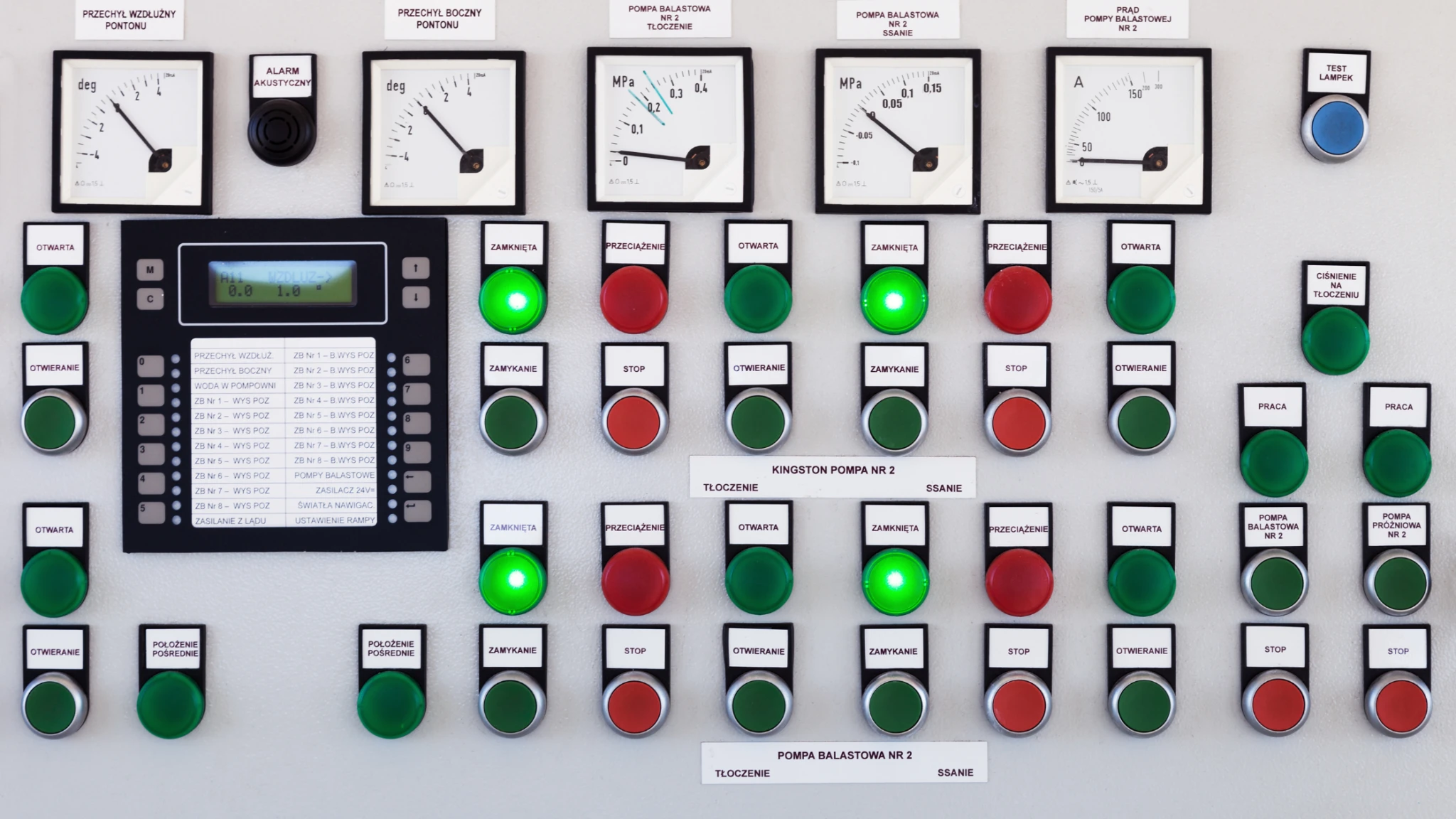
Figure 2: Professional diesel generator control panel displaying critical parameters. Modern controllers monitor voltage, frequency, oil pressure, coolant temperature, and provide remote monitoring capabilities for proactive maintenance.
Power Rating and Sizing: How to Calculate What You Actually Need
Undersizing a diesel generator is a disaster waiting to happen. Oversizing wastes capital and fuel. The challenge? Your “power needs” aren’t a single number—they’re a complex load profile that changes throughout the day and includes starting surges that can be 3-6 times normal running power.
Start With a Load Inventory
Grab a spreadsheet and list every piece of equipment the generator will power:
- Running watts (kW): What each device draws during normal operation
- Starting watts: The surge when motors, compressors, and transformers first energize
- Operating hours: When each load runs (not everything runs simultaneously)
For a diesel generator for home use, you might add up refrigerators, HVAC, lights, and critical outlets. For industrial applications, include manufacturing equipment, HVAC systems, elevators, IT infrastructure, and safety systems.
Understanding kW vs. kVA
You’ll see generators rated in both kilowatts (kW) and kilovolt-amperes (kVA). Here’s the difference:
- kW measures real power—the actual work being done
- kVA measures apparent power—the total electrical load including reactive power from inductive loads (motors, transformers)
The relationship depends on your power factor (typically 0.8 for industrial loads). A 400 kVA unit at 0.8 power factor delivers 320 kW. If your load has a poor power factor, you need a bigger kVA rating than your kW calculation suggests.
Account for Site Conditions
Manufacturers rate generators at specific conditions (usually 25°C and sea level). Your actual site might be different:
- Altitude: Expect about 3-4% power loss per 1,000 feet above sea level
- Temperature: High ambient temperatures reduce cooling efficiency and available power
- Parasitic loads: Cooling fans, block heaters, and battery chargers consume power before anything reaches your facility
A unit rated for 500 kW at sea level might deliver only 450 kW at 5,000 feet elevation. Always get a derated specification from your supplier for your actual installation conditions.
Add Safety Margin
After calculating your total load, add 20-25% capacity margin for:
- Future expansion
- Unforeseen loads
- Maintaining efficiency (generators run most efficiently at 70-80% load)
- Allowing the unit to handle transients without overload
That margin isn’t waste—it’s operational flexibility that prevents you from replacing the entire unit when you add equipment next year.
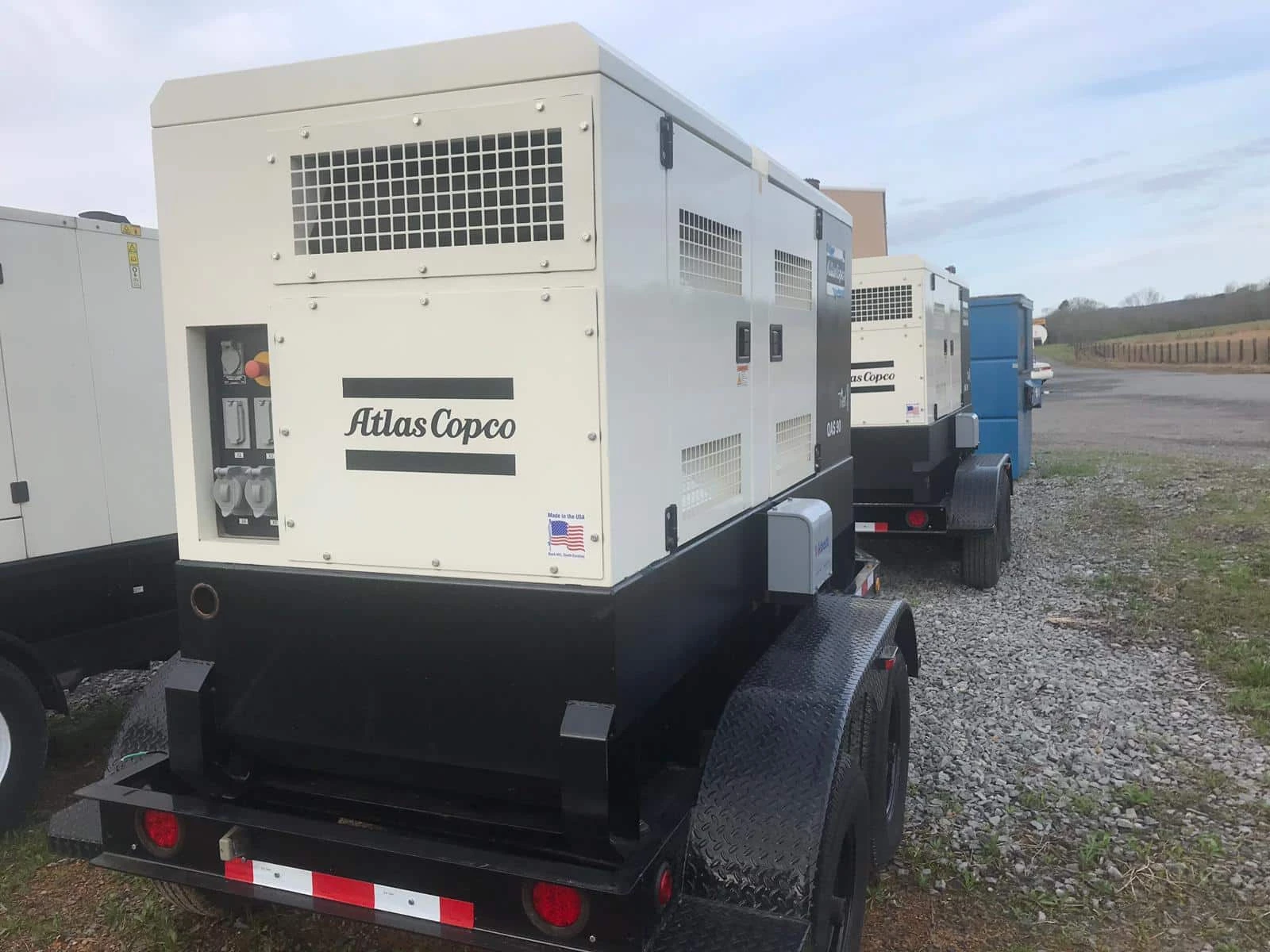
Figure 3: Portable diesel generators on job site demonstrating mobile power solutions. Trailer-mounted units provide flexibility for construction, events, and temporary power applications where permanent installation isn’t feasible.
Fuel Efficiency and Operating Costs: The Real Numbers
How much diesel does a generator use? It’s one of the first questions smart buyers ask, because fuel costs can dwarf your initial purchase price over the unit’s lifespan. The answer depends on load, engine efficiency, and how well the unit is maintained.
Typical Consumption Rates
Manufacturers publish fuel consumption at different load levels (usually 25%, 50%, 75%, and 100% of rated power). Here’s what you can expect from a modern industrial generator:
- 200 kVA unit at 50% load: ~6 gallons per hour
- 200 kVA unit at 100% standby load: ~10 gallons per hour
- 330 kVA unit at 50% prime load: ~10 gallons per hour
- 330 kVA unit at 100% prime load: ~20 gallons per hour
Notice the non-linear relationship—doubling the load doesn’t double fuel consumption, but it’s close. Running at partial load is less efficient per kW delivered, which is another reason to size appropriately.
Why Diesel Beats Gasoline for Most Commercial Applications
Are diesel generators more efficient? Yes, significantly. Diesel engines convert fuel to mechanical energy at roughly 35-45% efficiency compared to 25-30% for gasoline. Beyond raw efficiency:
- Diesel fuel contains more energy per gallon (~138,000 BTU vs. ~115,000 BTU for gasoline)
- Diesel engines are built for durability and long-run operation, with heavier components and better cooling
- Diesel fuel is less volatile and safer to store in large quantities
- Operating costs per kWh are typically 20-30% lower over the generator’s life
The trade-off? Diesel generators cost more upfront and have higher maintenance expenses. But for anything beyond light backup duty, the operational savings justify the investment.
Calculating Your Fuel Budget
Let’s say you’re considering a 250 kW unit for a manufacturing facility:
- Estimate annual runtime (emergency backup might be 100 hours/year; prime power could be 4,000+ hours/year)
- Estimate average load (most facilities run 60-70% of capacity)
- Use manufacturer data sheets for consumption at that load
- Multiply by local diesel price and add 10-15% for DEF (diesel exhaust fluid) if it’s a Tier 4 engine
For 500 hours/year at 70% load with a 250 kW unit consuming ~12 gph at that level, at $4/gallon diesel: 500 hrs × 12 gph × $4 = $24,000/year. Over a 20-year life, that’s $480,000—compare that to a $50,000-80,000 purchase price and you see why fuel efficiency matters more than the initial discount.
Quality manufacturers like Tesla Power publish verified fuel consumption data. Always ask for it, and be skeptical of anyone who won’t provide load-specific numbers.
Key Applications by Industry: Where Diesel Gensets Excel
Different industries have wildly different power requirements. Understanding your sector’s typical needs helps you ask the right questions and avoid solutions designed for someone else’s problems.
Healthcare Facilities: Hospitals and clinics need standby power that starts within 10 seconds and runs for days. Life-safety systems, operating rooms, and patient monitoring can’t tolerate interruptions. Expect dual or triple redundancy, automatic transfer switches, and prime-rated units sized for 100% facility load plus growth.
Data Centers: Uptime is measured in “nines”—even 99.9% availability means 8.7 hours of downtime per year, which is unacceptable for Tier III or IV facilities. Data centers use N+1 or 2N redundancy with continuous duty ratings, sophisticated paralleling controllers, and fuel systems designed for multi-day runtime. The genset is part of a system that includes UPS, automatic transfer switches, and utility coordination.
Manufacturing and Industrial: Factories face two scenarios. Process industries (chemical, refining, food production) often can’t shut down mid-batch, so they need reliable prime power or continuous backup. Other manufacturers use gensets to shave peak demand charges or provide resilience during frequent rural outages. Load management (shedding non-critical loads during generation) becomes important here.
Construction Sites: Remote projects rely on portable diesel generators as primary power. These units take a beating—dust, temperature swings, frequent transport. Durability and serviceability matter more than cutting-edge controls. Trailer-mounted units with weather enclosures are standard.
Telecommunications: Cell towers and switching centers need automatic, unattended operation. Gensets might run for 24-72 hours before technicians can reach remote sites. Remote monitoring, automatic start/stop, and extended fuel capacity are critical. These installations often combine solar with diesel for extended autonomy.
Commercial Buildings: Office buildings, retail centers, and multifamily residential use gensets to maintain elevators, fire safety systems, emergency lighting, and sometimes HVAC during outages. Regulations (NFPA 110) often dictate automatic transfer and testing schedules. Noise restrictions may require ultra-quiet enclosures or indoor installation with proper ventilation.
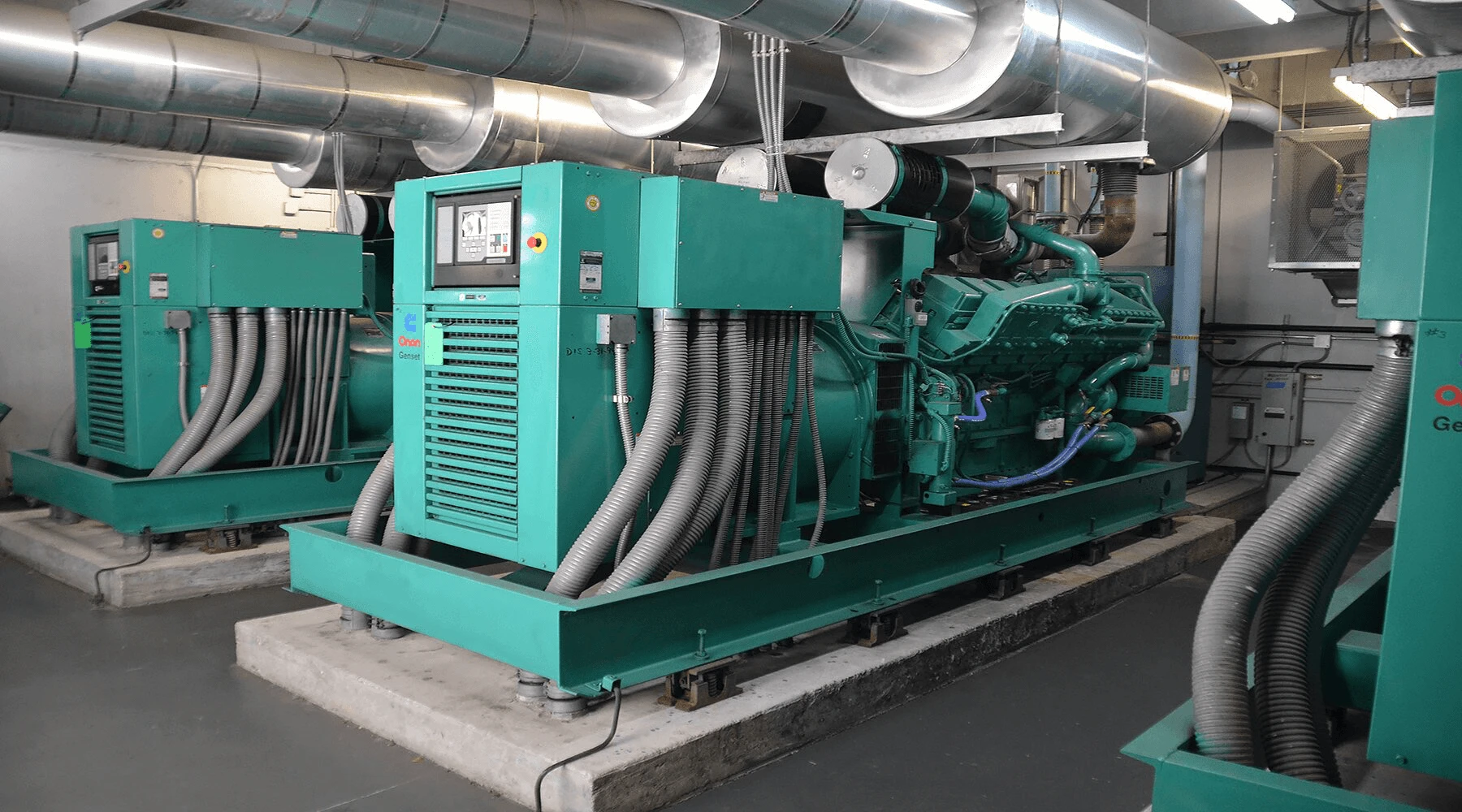
Figure 4: Large-scale diesel generators installed in critical facility infrastructure. Data centers and hospitals require redundant power systems with proper ventilation, exhaust routing, and accessibility for maintenance.
Selection Criteria Checklist: The Factors That Actually Matter
You’ve done the calculations. Now you’re comparing spec sheets from three manufacturers, and the numbers seem similar—but prices vary by 30%. What separates a good genset from a great one? Focus on these decision points:
1. Engine and Alternator Pedigree
The engine is your biggest reliability factor. Tier-one manufacturers (Cummins, Perkins, MTU, Caterpillar) have decades of field data proving durability. Lesser-known brands might work fine for light duty, but if you’re betting your business on uptime, pay for the proven platform. Same logic applies to alternators—Stamford, Leroy Somer, and Marathon are industry standards for a reason.
2. Controller Sophistication
A basic controller starts the engine and monitors voltage. Advanced controllers from Tesla Power and similar manufacturers offer:
- Remote monitoring via cellular or ethernet
- Predictive maintenance alerts based on operating hours and conditions
- Paralleling capability (running multiple gensets together for scalability)
- Load management (automatically shedding non-critical loads)
- Integration with building management systems
The controller upgrade might add $5,000-15,000, but it can save that much in a single prevented failure or avoided service call.
3. Emissions Compliance
U.S. EPA regulations divide stationary engines into categories based on size, application, and installation date. Key points:
- New engines: Most comply by purchasing EPA-certified units and following manufacturer instructions
- Emergency vs. non-emergency: Emergency engines have limited run hours (typically 100 hrs/year for testing plus unlimited emergency use); non-emergency engines can run more but face stricter emissions limits
- Tier 4 engines: Use aftertreatment (DOC, SCR, DPF) which requires DEF and periodic regeneration—adds complexity but meets current standards
- Permitting: Some jurisdictions require air quality permits even for emergency gensets; check with your state environmental agency before purchase
Get this wrong, and you could face fines or discover you can’t legally use the unit for your intended purpose.
4. Noise Levels
Manufacturers rate sound in dB(A) at a specified distance (usually 7 meters / 23 feet). Typical ranges:
- Open-frame industrial gensets: 85-95 dB(A) @ 7m
- Standard enclosure: 75-82 dB(A) @ 7m
- Super-silent enclosure: 65-72 dB(A) @ 7m
For context, 75 dB(A) is about as loud as a busy highway; 65 dB(A) is conversational speech. Urban installations and residential areas often require the quieter (and pricier) options. Don’t guess—check local noise ordinances and measure from where neighbors or occupants will be.
5. Fuel Tank Size and Certification
Runtime = tank capacity ÷ fuel consumption. A 500-gallon tank on a unit burning 15 gph gives you 33 hours of continuous operation. Sounds good, until you realize that an ice storm might knock power out for a week, and fuel deliveries can’t reach you.
Also check tank certifications. UL-142 is standard for aboveground tanks; UL-2085 is for protected aboveground tanks with fire resistance. Some jurisdictions require double-wall tanks or secondary containment. Installing a larger certified tank later is expensive—spec it right the first time.
6. Serviceability and Parts Availability
A generator is worthless if you can’t get it repaired. Ask:
- Is there a factory-authorized service center within 100 miles?
- What’s the typical lead time for critical parts (injectors, alternator components, controllers)?
- Does the manufacturer offer emergency parts shipping?
- Can local technicians work on this engine platform, or does it require specialized training?
Exotic European gensets might have impressive specs, but if you’re waiting three weeks for a proprietary controller board, your impressive specs don’t matter.
7. Warranty and Service Plans
Standard warranties run 1-2 years or 2,000 operating hours. Look for:
- Extended warranties: Available for purchase, often worth it for critical applications
- Comprehensive coverage: Some warranties exclude wear items, filtration, or damage from “improper operation” (broadly defined)
- Preventive maintenance agreements: For a fixed annual fee, the manufacturer handles all scheduled service, often including emergency response
The cheapest unit with a weak warranty can become the most expensive when you’re paying $200/hour for emergency service calls.
Installation and Compliance: Don’t Skip These Steps
Buying the generator is one thing. Installing it correctly and legally is another. Shortcuts here lead to failed inspections, voided warranties, and equipment damage.
NFPA 110 and Emergency Power Supply Systems
If you’re installing an Emergency Power Supply System (EPSS)—required for hospitals, high-rise buildings, and other life-safety applications—NFPA 110 is your bible. It specifies:
- Performance levels (how long the system has to start and pick up load)
- Testing requirements (monthly exercise under load, annual full-load tests)
- Fuel supply (enough on-site fuel for the required runtime, typically 4-48 hours depending on classification)
- Maintenance (documented preventive maintenance programs)
Your Authority Having Jurisdiction (local building/fire department) will inspect against NFPA 110. Work with contractors who understand these requirements—residential electricians aren’t qualified for this work.
Site Requirements
Ventilation: Diesel generators need massive airflow for combustion and cooling. Manufacturers specify exhaust temperature, flow rate, and acceptable backpressure. Undersized ventilation leads to overheating and reduced power output. Indoor installations need dedicated supply and exhaust openings sized to manufacturer specs.
Exhaust System: Exhaust gas temperatures can exceed 1,000°F. You need properly sized piping, supports, and clearances from combustible materials. Rain caps prevent water ingress. Flexible connections isolate vibration. This isn’t a DIY project.
Concrete Pad: Gensets create vibration. You need a properly designed concrete pad (typically 6″ thick, reinforced) that’s level, drains away from the unit, and can support the loaded weight (unit + full fuel tank). Spring isolators can reduce transmitted vibration for noise-sensitive installations.
Clearances: Manufacturers specify minimum clearances for service access, cooling airflow, and fire safety. Typical requirements:
- 3-5 feet on the service side for maintenance access
- 2-3 feet on other sides for airflow
- 10+ feet from building openings (windows, doors, air intakes) to prevent exhaust ingestion
Electrical Integration
Your diesel genset connects through an Automatic Transfer Switch (ATS) that senses utility failure, starts the generator, and switches loads. Key decisions:
- Transfer switch rating: Must handle your peak load plus a margin
- Transfer time: How long can critical loads tolerate interruption? (UPS systems fill the gap for sensitive equipment)
- Open vs. closed transition: Open transition briefly interrupts power; closed transition (more expensive) transitions smoothly
- Load shedding: Critical loads transfer first; non-essential loads might stay on utility or shed entirely
Everything must meet National Electrical Code (NEC) Article 700 (Emergency Systems) or Article 701 (Legally Required Standby Systems) or Article 702 (Optional Standby Systems), depending on your application.
Permitting
Expect to file for:
- Building permit: For the pad, enclosure, and structural work
- Electrical permit: For all wiring and transfer switches
- Air quality permit: Some states require permits for stationary engines above certain thresholds, even emergency units
- Noise variance: If your unit exceeds local noise limits
Start the permit process early—some air quality permits take months. Your contractor should handle this, but verify they’re actually filing and not cutting corners.
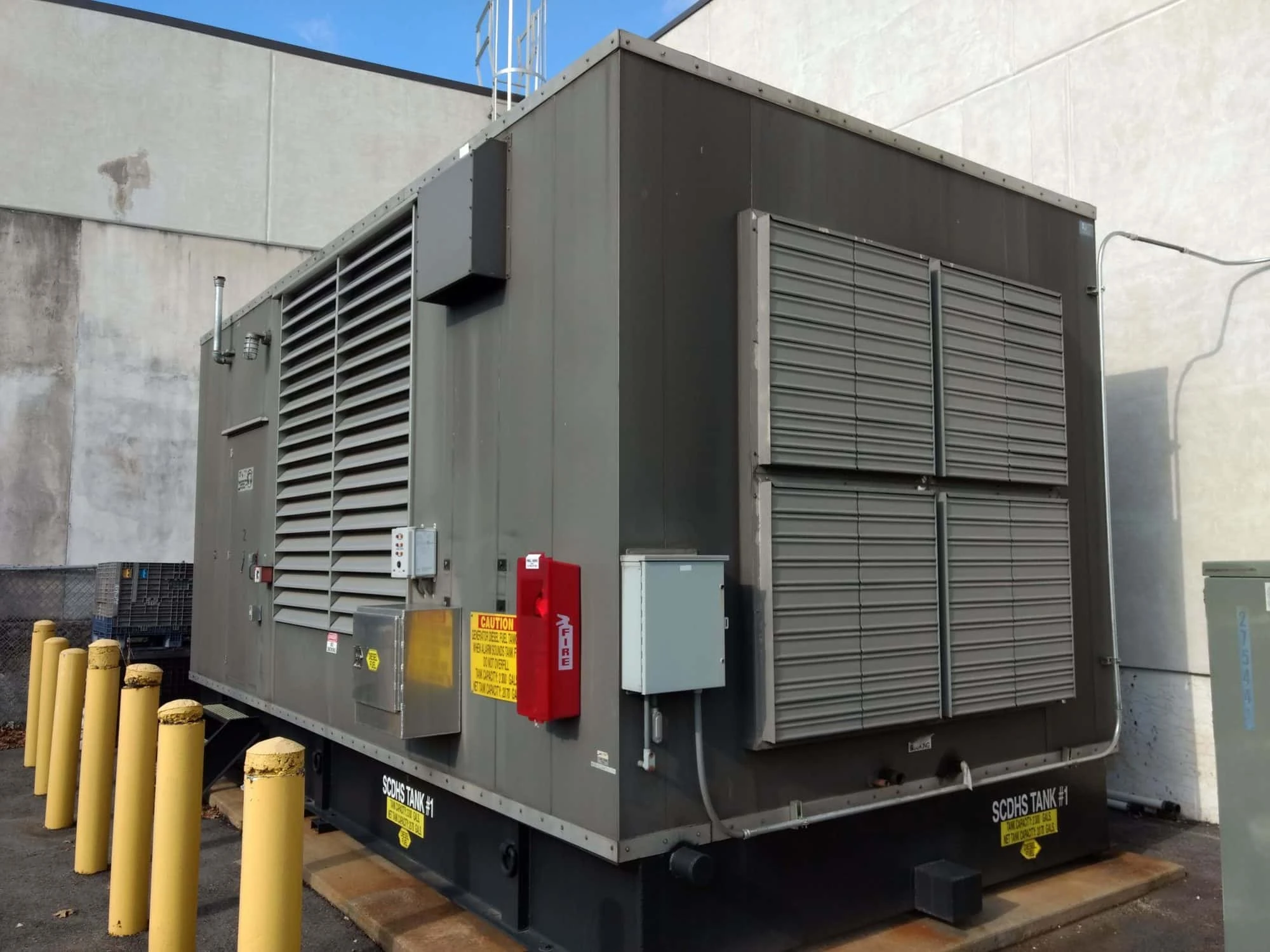
Figure 5: Properly installed stationary diesel generator with safety equipment and protective bollards. Professional installation includes proper clearances, fire suppression access, secure mounting, and compliance with NFPA 110 standards.
Maintenance Requirements: How to Keep Your Investment Running
How long can a diesel generator run continuously? With proper maintenance, industrial units can run 20,000-30,000 hours before major overhaul—that’s years of operation. But skip maintenance, and you’ll be rebuilding or replacing at 5,000 hours. Generator maintenance isn’t optional.
The Core Maintenance Schedule
Manufacturers publish detailed schedules, but expect these basics:
Daily (during operation):
- Visual inspection for leaks, damage, unusual noise
- Check fluid levels (oil, coolant, fuel)
- Review control panel for alarms or warnings
Monthly or After 25-50 Operating Hours:
- Exercise the unit under load (critical for emergency units that sit idle)
- Check battery voltage and electrolyte
- Inspect belts and hoses
- Test automatic start function
Every 250-500 Hours or Annually:
- Change engine oil and filters
- Replace fuel filters
- Check coolant concentration and condition
- Inspect air filter (replace if dirty; critical in dusty environments)
- Test batteries under load
- Verify correct voltage and frequency output
Every 500-1000 Hours:
- Valve adjustment (if not self-adjusting)
- Inspect and clean cooling system
- Load bank testing (apply full rated load to verify performance)
- Check exhaust system for leaks or deterioration
Every 2-3 Years or 2,000-3,000 Hours:
- Replace coolant
- Comprehensive alternator inspection
- Governor/controller calibration
- Professional diagnostic review
Why Exercise Runs Matter
Diesel generators that sit unused develop problems: fuel degrades, seals dry out, batteries discharge, and carbon builds up in the exhaust. Monthly exercise runs (at least 30 minutes under at least 30% load) prevent these issues. NFPA 110 requires monthly testing for emergency systems—it’s not bureaucracy, it’s proven reliability practice.
Maintenance Options
You have three approaches:
In-house maintenance: If you have qualified technicians, engine diagnostics tools, and time to stay current on training. Works for large facilities with multiple units. Requires maintaining parts inventory and documentation.
Manufacturer service contracts: Fixed annual fee, scheduled visits, emergency response included. These contracts typically cost 3-5% of the generator’s purchase price annually but guarantee factory-trained technicians and genuine parts. Recommended for critical applications where downtime is unacceptable.
Independent service providers: Middle ground on cost and capability. Quality varies wildly—vet them carefully. Make sure they’re familiar with your specific engine and alternator models and can get parts quickly.
Skimping on maintenance to save $2,000/year is false economy when a major failure costs $30,000+ in repairs plus the value of your downtime.
Making the Final Decision: Tools and Resources
You’ve gathered requirements, calculated loads, researched options, and reviewed quotes. Now what? Use these tools to validate your decision:
Manufacturer Selection Tools: Most major manufacturers (including Tesla Power, Cummins, and Caterpillar) offer online sizing calculators. Input your load list, duty cycle, and site conditions; get recommended models. Use multiple calculators as a cross-check.
Third-Party Load Calculators: Engineering firms and consultants publish free tools. These aren’t brand-specific and can provide unbiased sizing guidance.
Energy Audits: For complex facilities, hire a consultant to perform a detailed power audit. They’ll measure actual loads, power factor, starting currents, and harmonics. A $5,000 audit can prevent a $50,000 sizing mistake.
Spec Review: Before signing, have an independent engineer review the full specification package: genset nameplate data, site-specific derates, controller capabilities, fuel system sizing, exhaust and ventilation calculations, and compliance documentation. Look for gaps between what you need and what’s being proposed.
References and Case Studies: Ask potential suppliers for customer references in similar applications. Call them. Ask about reliability, service response, hidden costs, and whether they’d buy the same unit again.
Total Cost of Ownership: Build a spreadsheet covering 10-20 years:
- Purchase price + installation + permitting
- Annual fuel costs at expected runtime
- Maintenance (parts, labor, service contract)
- Insurance and property tax
- Major overhaul (typically at 15,000-20,000 hours)
The cheapest upfront option often costs more over its life. Conversely, gold-plating with features you don’t need wastes capital. Find the balance where you’re paying for reliability and capacity you’ll actually use.
Frequently Asked Questions
1. How does a diesel generator work?
A diesel generator combines a compression-ignition engine with an alternator to convert fuel into electrical power. The engine compresses air to high pressure and temperature (no spark plugs needed), then injects diesel fuel which ignites spontaneously. This combustion drives pistons that turn a crankshaft, which spins the alternator to generate AC electricity. The control system monitors output voltage and frequency, adjusting engine speed to maintain stable power. Modern units include sophisticated controllers, cooling systems, fuel management, and exhaust aftertreatment (for emissions compliance) all integrated into a single package. This design makes diesel gensets more fuel efficient and durable than gasoline alternatives, especially for sustained operation under heavy loads.
2. Which is better: diesel or gasoline generator?
For commercial and industrial applications, diesel generators win on nearly every metric. Diesel engines deliver 35-45% thermal efficiency versus 25-30% for gasoline, meaning lower fuel costs per kilowatt-hour produced. Diesel fuel contains more energy per gallon and stores more safely in bulk quantities. Diesel engines are engineered for continuous-duty operation with heavier components, better cooling, and longer service intervals—expect 20,000-30,000 hours between major overhauls compared to 10,000-15,000 for gasoline. The trade-off? Diesel units cost 20-40% more upfront and require more sophisticated maintenance. Gasoline generators make sense for light backup duty (under 100 hours/year), portable diesel generators smaller than 10 kW, or where diesel fuel isn’t readily available. But for anything requiring reliable prime power, extended runtime, or ratings above 20 kW, diesel is the professional choice.
3. How long can a diesel generator run continuously?
It depends on the duty rating and maintenance quality. A properly maintained industrial generator rated for continuous duty (COP) can theoretically run indefinitely as long as fuel is supplied and routine maintenance is performed. In practice, most operators schedule maintenance shutdowns every 250-500 operating hours for oil changes and inspections. Prime-rated (PRP) units are designed for unlimited hours per year with variable loads and can run for weeks between shutdowns—data centers and remote facilities routinely operate their gensets for days or even weeks during extended outages. Emergency standby (ESP) units have more conservative ratings and should follow manufacturer limits on consecutive runtime, typically allowing several days of continuous operation during emergencies. The real limiting factors are fuel supply, maintenance schedule, and ambient conditions (heat waves reduce available power). Well-maintained units with adequate cooling and fuel can easily run 500+ hours continuously, and I’ve seen properly specified sets run for 1,000+ hours during major disasters.
4. What size diesel generator do I need for my business?
Start by listing every device the generator must power, noting both running watts and starting watts (motors and compressors draw 3-6x normal power when starting). Add up simultaneous loads—not everything runs at once. Account for power factor (industrial loads typically need 1.25x more kVA than kW). Then apply site derates: subtract 3-4% per 1,000 feet elevation and adjust for ambient temperature above 25°C (manufacturers provide derate charts). Add 20-25% margin for efficiency, future expansion, and transient capability. Example: If your facility needs 200 kW at sea level, you might need a 250-300 kW unit at 5,000 feet elevation with room for growth. Don’t forget to match duty rating to your usage pattern—a unit sized for standby power (ESP rating) needs to be physically larger than the same capacity in prime power (PRP rating). When in doubt, get a professional load calculation; undersizing costs far more than slightly oversizing.
5. What maintenance does a diesel generator require?
Regular generator maintenance is non-negotiable for reliability. Monthly: exercise the unit under load for 30+ minutes (NFPA 110 requirement for emergency systems), inspect for leaks or damage, test automatic start. Every 250-500 hours or annually: change oil and filters, replace fuel filters, check coolant and battery condition, inspect belts and air filter, verify voltage and frequency output. Every 500-1,000 hours: load bank testing (verify full-rated output), cooling system service, exhaust inspection, valve adjustment if needed. Every 2-3 years: coolant replacement, comprehensive alternator inspection, controller calibration. Keep detailed logs of all maintenance—many failures trace back to skipped service. Plan on annual maintenance costs of 3-5% of the generator’s purchase price if you use a professional service contract, less if you have qualified in-house technicians. The alternative—discovering maintenance was neglected when you actually need the generator—is far more expensive. Quality manufacturers like Tesla Power provide detailed maintenance schedules and often offer service contracts that bundle parts, labor, and emergency response into a predictable annual fee.