

When your facility loses power, every minute of downtime translates directly into lost revenue, compromised operations, and potentially dangerous situations. For businesses evaluating backup power solutions, the first question is always the same: what’s this actually going to cost? The answer isn’t as simple as a single price tag. A commercial standby generator represents a significant capital investment that involves not just the generator itself, but installation, infrastructure upgrades, permitting, and ongoing maintenance.
What buyers should confirm first
How Much Does a Commercial Standby Generator Cost to Install should be evaluated against the real load profile, voltage and frequency standard, duty rating, enclosure requirement, and installation environment before the order is confirmed.
Before requesting a quotation
- Confirm standby or prime duty and the expected running hours.
- Match site voltage, phase, and 50Hz or 60Hz requirement with the destination equipment.
- Check whether ATS, canopy, fuel tank, trailer, or remote monitoring are part of the same quote.
- Ask for the exact engine model, alternator model, controller type, and factory test scope.
Documents worth requesting
- Rated power table with standby and prime values clearly separated.
- Dimension and weight information for shipping, foundation, and room layout checks.
- Wiring diagram or ATS scope when the package includes switching equipment.
- Factory test record, packing list, and after-sales contact route for export support.
Related product resources
Understanding the full financial picture helps you budget accurately and avoid surprises during the procurement process. Whether you’re a facility manager planning for a hospital, a manufacturing plant, or a data center, knowing what drives generator installation cost allows you to make informed decisions and justify the investment to stakeholders.

Breaking Down Commercial Standby Generator Costs
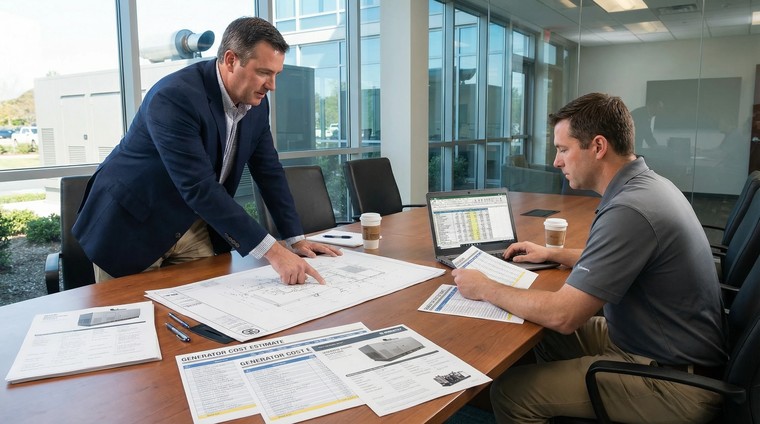
The total cost of a commercial standby generator project falls into three main categories: equipment purchase, installation and infrastructure, and ongoing operational expenses. Each category contains multiple line items that vary based on your facility’s specific requirements.
Equipment Purchase Price by Capacity
Generator pricing scales primarily with power output measured in kilowatts (kW). Here’s what you can expect across different capacity ranges:
50-100 kW Range: $10,000 – $25,000
These smaller standby power systems suit small commercial buildings, retail locations, or light manufacturing facilities. They typically run on natural gas or propane and provide enough capacity to keep critical systems online during outages.
100-200 kW Range: $25,000 – $60,000
Mid-sized generators serve medium commercial buildings, medical clinics, grocery stores, and mixed-use developments. At this range, you’ll find both natural gas and diesel generator options, with diesel typically costing 15-20% more due to fuel system complexity.
200-500 kW Range: $60,000 – $150,000
This capacity bracket handles larger facilities including small hospitals, manufacturing operations, distribution centers, and high-rise office buildings. Most units in this range are three-phase systems designed for commercial power distribution.
500-1,000 kW Range: $150,000 – $350,000
Large-scale industrial generator systems that power entire hospital campuses, data centers, large manufacturing plants, or multi-building commercial complexes. Leading manufacturers like Tesla Power offer extensive options in this range with advanced paralleling capabilities for even greater capacity.
1,000-2,000+ kW Range: $350,000 – $1,000,000+
Mission-critical installations requiring massive power output. These systems often involve multiple generators working in parallel with sophisticated controls. Price varies dramatically based on configuration, redundancy requirements, and emissions compliance levels.
What Drives Equipment Price Variations
Beyond raw capacity, several factors significantly impact generator pricing:
Fuel Type: Diesel generators typically cost more upfront than natural gas units of equivalent capacity. However, diesel offers faster starting, better performance in extreme cold, and fuel storage flexibility—factors that matter in many industrial applications.
Enclosure Type: A basic open-frame generator costs significantly less than a weather-resistant, sound-attenuated enclosure suitable for outdoor installation in urban environments. Sound attenuation alone can add $10,000-$50,000 depending on decibel reduction requirements and generator size.
Emissions Compliance: Meeting stringent EPA Tier 4 Final emissions standards requires advanced after-treatment systems that add 15-25% to the base generator cost. Facilities in non-attainment areas or near sensitive receptors often face these requirements.
Controls and Monitoring: Advanced digital controllers with remote monitoring, automatic load management, and cloud connectivity cost more than basic controls but provide valuable operational visibility. Tesla Power and other manufacturers now include IoT-enabled monitoring as standard on many commercial models.
Related Posts
Installation and Infrastructure Costs
For most projects, installation expenses equal or exceed the generator purchase price. Here’s where those costs accumulate:
Site Preparation and Foundation
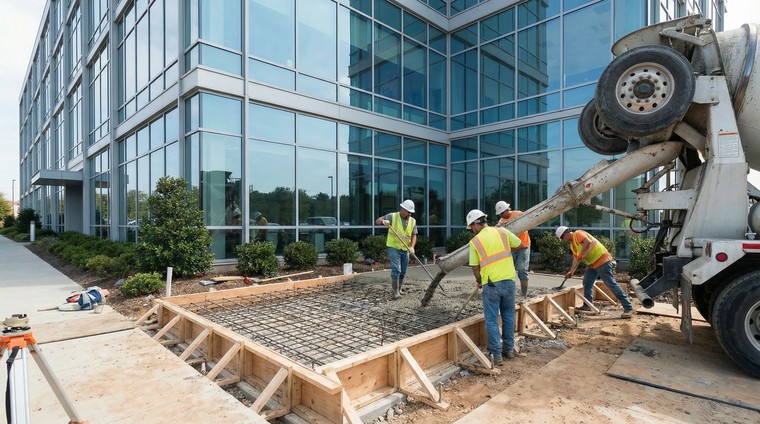
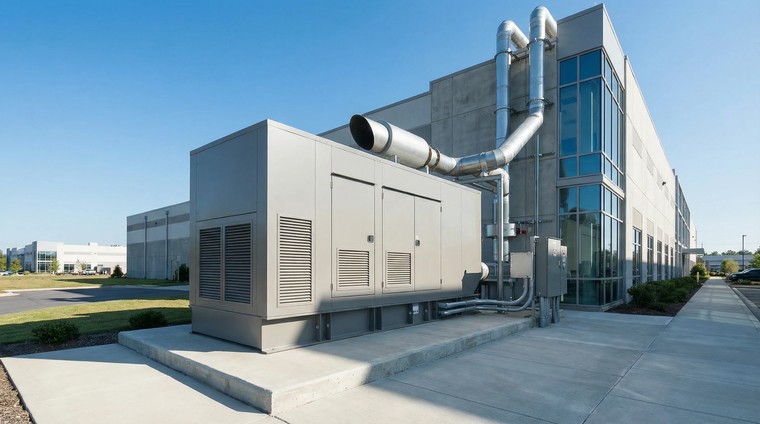
Generators require substantial concrete pads engineered to support the unit’s weight plus fuel tanks and associated equipment. Expect $5,000-$25,000 for foundation work depending on soil conditions, seismic requirements, and accessibility. Urban rooftop installations can cost significantly more due to structural reinforcement and crane access challenges.
Electrical Integration
This represents one of the largest installation cost drivers:
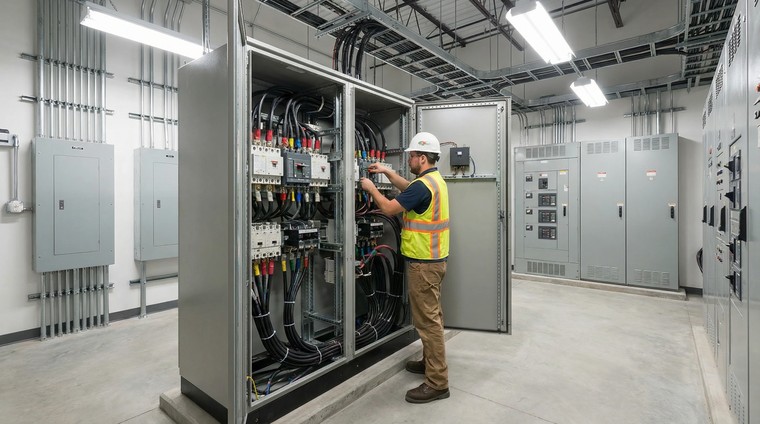
Automatic Transfer Switch (ATS): $3,000-$50,000 depending on amperage rating and switching speed requirements. A 400-amp ATS for a 150 kW system typically runs $8,000-$15,000 installed.
Main Distribution Panel Modifications: Integrating the generator into your facility’s existing electrical infrastructure often requires panel upgrades, additional breakers, and rewiring. Budget $5,000-$30,000 for electrical integration work.
Conduit and Wiring: Running heavy-gauge conductors from the generator to the ATS and service entrance adds $2,000-$15,000 depending on distance and accessibility.
Fuel System Installation
Natural gas units need a service line upgrade from the utility (often $5,000-$20,000) plus a pressure regulator and gas train ($2,000-$8,000).
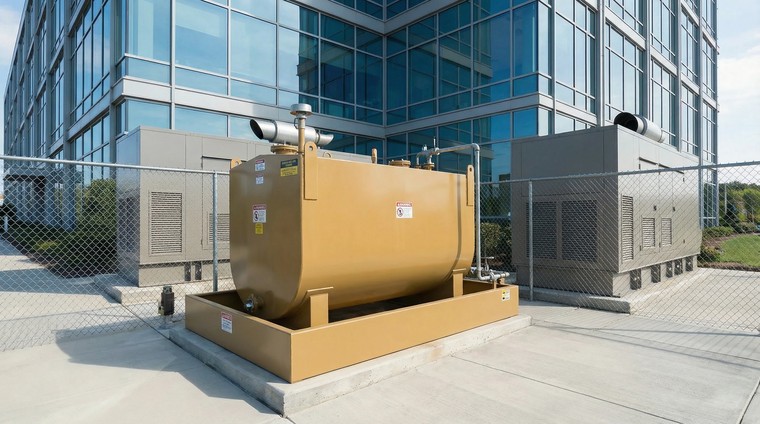
Diesel systems require above-ground or underground fuel storage tanks. A 500-gallon above-ground tank with secondary containment costs $8,000-$15,000. Underground tanks meeting current environmental regulations start at $25,000 and can exceed $100,000 for large-capacity installations with leak detection and monitoring systems.
Propane systems need a large-capacity tank (often leased from the supplier) plus installation of gas lines and regulators, typically $10,000-$30,000.
Exhaust and Ventilation
Commercial generators require properly sized exhaust systems with code-compliant clearances from building openings and property lines. Exhaust piping, silencers, and ventilation grilles add $3,000-$20,000 depending on configuration and run length.
Permitting and Engineering
Don’t overlook soft costs:
- Building permits: $500-$5,000
- Electrical permits: $500-$3,000
- Environmental permits (diesel): $1,000-$10,000
- Engineering stamped drawings: $2,000-$15,000
- Acoustic studies (if required): $3,000-$10,000
- Commissioning and testing: $2,000-$10,000
Total installation costs typically run 80-150% of the generator equipment cost. A $50,000 generator might have a total installed cost of $90,000-$125,000.
Ongoing Operational Costs
Backup generator pricing extends beyond the initial investment into long-term ownership costs that impact your total cost of ownership (TCO) over the unit’s 20-30 year lifespan.
Preventive Maintenance
Standby generators require regular maintenance to ensure they start reliably when needed:
- Monthly exercising: Most codes require running the generator under load monthly. This consumes fuel and incurs wear, typically costing $50-$200 per month in fuel and operator time.
- Semi-annual service: Oil and filter changes, coolant testing, battery checks, and minor adjustments run $500-$1,500 per visit depending on generator size.
- Annual service: Comprehensive inspection including load bank testing, valve adjustments, and full system checks costs $1,500-$5,000 annually.
Manufacturers like Tesla Power offer maintenance contracts that bundle these services for predictable annual costs, typically 2-4% of the generator’s purchase price per year.

Major Service Intervals
Plan for significant maintenance events:
- 500-1,000 hour service (varies by manufacturer): $3,000-$10,000
- Engine overhaul (8,000-15,000 hours or 15-20 years): $20,000-$100,000 depending on generator size
Fuel and Utility Costs
Monthly exercising consumes 10-50 gallons of diesel or equivalent natural gas depending on generator size. Annual fuel costs for exercising alone run $200-$2,000.
Natural gas units may require minimum demand charges from the utility if a dedicated meter is installed, adding $500-$2,000 annually.
Insurance and Compliance
Some insurance carriers offer premium reductions for facilities with backup power, potentially offsetting costs. Conversely, diesel fuel storage may increase environmental insurance requirements.
Annual emissions testing and compliance documentation for diesel generators in regulated areas adds $500-$3,000 per year.
Calculating Return on Investment
Justifying the cost of a commercial standby generator requires quantifying the cost of downtime for your specific operation. Here’s a framework:
Downtime Cost Analysis
Start by calculating your hourly downtime cost:
- Lost revenue (e.g., manufacturing output, retail sales)
- Spoiled inventory (food service, pharmaceuticals)
- Lost productivity (employee wages without output)
- Recovery costs (restart procedures, damaged equipment)
- Reputation and customer impact (harder to quantify but very real)
A mid-sized manufacturing facility might experience $10,000-$50,000 in direct costs per hour of downtime. A hospital faces patient safety issues that transcend simple financial calculations. Data centers contractually commit to uptime SLAs that trigger substantial penalties for outages.
Payback Period Calculation
Compare your total installed cost against annual outage exposure:
Example: A 200 kW commercial generator with total installed cost of $120,000 protecting a facility with $25,000/hour downtime costs:
- If you experience 6 hours of outages annually (roughly the U.S. commercial average), your annual exposure is $150,000
- Payback period: less than 1 year
- Over 20-year lifespan with $100,000 in total maintenance costs, you’re protecting $3 million in potential losses for $220,000 total investment
Even facilities with good utility reliability find payback periods of 2-5 years quite common when downtime costs are significant.
Financing and Incentives
Many businesses finance generator installations through:
- Equipment financing (5-7 year terms at 4-8% interest)
- Building improvement loans
- Operating leases
Some jurisdictions offer incentives for backup power in critical facilities or for emissions-compliant systems. Check with your utility and local economic development office.
Real-World Cost Examples
To make this concrete, here are three recent generator installation projects:
Medical Clinic (150 kW natural gas):
- Generator: $45,000
- ATS and electrical: $18,000
- Gas service upgrade: $12,000
- Pad and installation: $15,000
- Permits and engineering: $6,000
- Total: $96,000
Manufacturing Plant (500 kW diesel):
- Generator with enclosure: $180,000
- 1,000-gallon underground tank: $45,000
- ATS and paralleling gear: $60,000
- Electrical integration: $35,000
- Foundation and installation: $30,000
- Permits and commissioning: $15,000
- Total: $365,000
Data Center (1,200 kW in dual 600 kW units):
- Two generators with N+1 redundancy: $520,000
- Fuel system (above-ground tanks): $80,000
- Dual ATS and distribution: $120,000
- Electrical and controls: $90,000
- Structural and installation: $75,000
- Engineering and commissioning: $35,000
- Total: $920,000
These examples illustrate how installation complexity and infrastructure requirements drive total costs beyond equipment pricing.
Budget Planning Best Practices
When planning your standby power systems investment, follow these guidelines:
1. Start Early: Generator procurement and installation typically takes 4-8 months from initial planning to commissioning. Long-lead items like custom switchgear or large diesel tanks can extend timelines.
2. Get Multiple Quotes: Prices vary significantly between contractors. Get at least three detailed quotes that break out equipment, installation, and infrastructure costs separately. This helps you understand where money is going and compare apples-to-apples.
3. Value Engineering: Work with your contractor to identify cost-saving opportunities without compromising reliability:
- Natural gas vs. diesel trade-offs
- Right-sizing capacity (oversizing wastes money)
- Phased installation approaches
- Standard vs. custom equipment
4. Don’t Cheap Out on Critical Components: While value engineering makes sense, certain areas deserve premium investment:
- Commercial-grade ATS (not residential)
- Proper fuel filtration and conditioning
- Quality installation (poor grounding or connections cause most problems)
- Comprehensive commissioning and testing
5. Plan for Total Cost of Ownership: The lowest upfront bid isn’t always the best value. Consider fuel efficiency, maintenance costs, parts availability, and local service support. Manufacturers like Tesla Power with strong dealer networks provide better long-term value through accessible service and parts.
6. Document Everything: Detailed specifications, drawings, and commissioning reports become invaluable for insurance, code compliance, and future maintenance. Budget for proper documentation as part of your project.
Working with the Right Partners
Successful generator projects depend on experienced partners:
Manufacturers: Choose established brands with proven track records in commercial applications. Tesla Power and other tier-one manufacturers offer:
- Extensive product ranges meeting diverse needs
- Technical support and engineering assistance
- Parts availability and warranty backing
- Training for maintenance personnel
Dealers and Contractors: Look for authorized dealers who can:
- Perform accurate load studies and sizing
- Navigate permitting and code requirements
- Provide turnkey installation
- Offer ongoing maintenance and emergency service
- Support generator paralleling and complex systems
Engineers: For large or complex installations, engage a consulting engineer experienced with emergency power systems. Their fees (typically $5,000-$30,000) are small compared to the cost of undersized or improperly integrated systems.
Frequently Asked Questions
How much does a 100 kW commercial standby generator cost installed?
A 100 kW natural gas generator typically costs $20,000-$35,000 for the equipment. With installation, ATS, fuel system, and permits, expect total installed costs of $45,000-$85,000 depending on site conditions and infrastructure requirements. Diesel units in this range run 10-15% higher.
What’s the price difference between diesel and natural gas generators?
Diesel generators cost 15-25% more upfront for comparable capacity due to fuel systems and storage requirements. However, diesel offers advantages in cold climates, faster starting, and fuel storage flexibility. Natural gas units have lower installation costs if gas service is readily available but depend on utility infrastructure during emergencies.
How long do commercial generators last, and when do major costs occur?
Commercial standby generators typically last 20-30 years with proper maintenance. Expect major expenses around 15-20 years when engine overhauls become necessary ($20,000-$100,000 depending on size). Budget 2-4% of purchase price annually for routine maintenance plus $3,000-$10,000 every 500-1,000 hours for comprehensive service.
Are there financing options for commercial generator installations?
Yes, most businesses finance generator projects through equipment loans (5-7 years), commercial property improvement loans, or operating leases. Many dealers offer financing programs with competitive rates. Given the substantial upfront costs, financing is common and allows businesses to spread payments over the system’s productive life while immediately gaining backup power protection.
What hidden costs should I budget for?
Common overlooked expenses include: utility connection fees for gas service upgrades ($2,000-$10,000), ongoing fuel for monthly testing ($200-$2,000 annually), acoustic testing or silencing if noise complaints arise ($5,000-$20,000), additional environmental insurance for fuel storage ($500-$3,000 annually), and emergency repair provisions (budget 1-2% annually for unplanned service). Also factor in electrical panel upgrades that may be triggered by code requirements when adding generator circuits.
Conclusion
The question “How much does a commercial standby generator cost?” doesn’t have a single answer—it depends on your facility’s power requirements, infrastructure, site conditions, and long-term operational needs. However, understanding the complete cost structure puts you in a strong position to budget accurately and make informed decisions.
For most commercial installations, expect total costs ranging from $50,000 for smaller systems to well over $1 million for large, complex installations with redundancy requirements. The investment becomes much easier to justify when you quantify your downtime costs and calculate the protection value over the system’s 20-30 year lifespan.
Start your planning process early, work with experienced partners, and focus on total cost of ownership rather than just upfront price. A well-designed commercial standby generator system from a reputable manufacturer like Tesla Power provides decades of reliable backup power protection that pays for itself many times over by keeping your facility operational when it matters most.
Ready to move forward? Connect with authorized dealers in your area for detailed load studies, site assessments, and project quotes tailored to your specific requirements.