

Table of Contents
What buyers should confirm first
How to Calculate the Right Industrial Diesel Generator Size for Your Factory should be evaluated against the real load profile, voltage and frequency standard, duty rating, enclosure requirement, and installation environment before the order is confirmed.
Before requesting a quotation
- Confirm standby or prime duty and the expected running hours.
- Match site voltage, phase, and 50Hz or 60Hz requirement with the destination equipment.
- Check whether ATS, canopy, fuel tank, trailer, or remote monitoring are part of the same quote.
- Ask for the exact engine model, alternator model, controller type, and factory test scope.
Documents worth requesting
- Rated power table with standby and prime values clearly separated.
- Dimension and weight information for shipping, foundation, and room layout checks.
- Wiring diagram or ATS scope when the package includes switching equipment.
- Factory test record, packing list, and after-sales contact route for export support.
Related product resources
What is Generator Sizing and Why Does it Matter?
Generator sizing is the process of determining the precise electrical capacity required to start and run your facility’s equipment simultaneously. It is typically measured in kilowatts (kW) or kilovolt-amperes (kVA).
If you undersize your unit, you risk voltage dips that damage sensitive electronics or cause the engine to stall. If you oversize, you face “wet stacking” (engine damage from running under light loads) and wasted capital expenditure. A properly sized diesel genset ensures operational continuity and longevity.
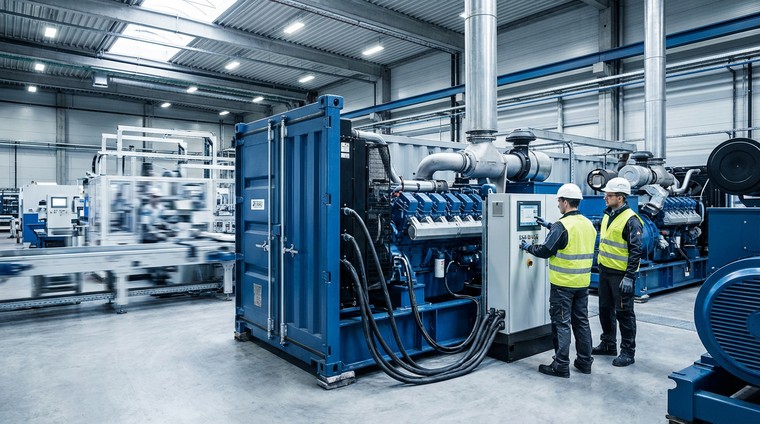
Key Factors Influencing Your Power Requirements
To calculate the size accurately, you must consider more than just the sum of your equipment’s nameplates. Here are the invisible factors that experienced engineers consider:
- Starting vs. Running Wattage: Electric motors (found in conveyors, pumps, and HVAC systems) require a massive surge of power to start—often 3 to 6 times their running wattage. This is known as inrush current. Your generator must handle this peak without dropping voltage significantly.
- Harmonic Distortion: Modern factories use Variable Frequency Drives (VFDs) and LED lighting. These non-linear loads create harmonics that can overheat generator windings. You may need a larger alternator to compensate for this.
- Duty Cycle: Are you looking for standby power (emergency use only) or prime power (running for extended periods)? A generator rated for 500kVA standby might only be valid for 450kVA in a prime application.
Tools to Utilize for Accurate Calculation
Stop guessing and start measuring. Here are the tools and methods professionals use:
- Power Analyzers: Hook these up to your main breaker for a week to log peak usage, power factor, and load profiles.
- Load Bank Testing: Before finalizing a purchase, simulate the load on the generator to verify it handles your specific peak load demand.
- Manufacturer Sizing Software: Most top-tier brands, including Tesla Power, offer sophisticated software that simulates motor starting sequences to recommend the exact model.
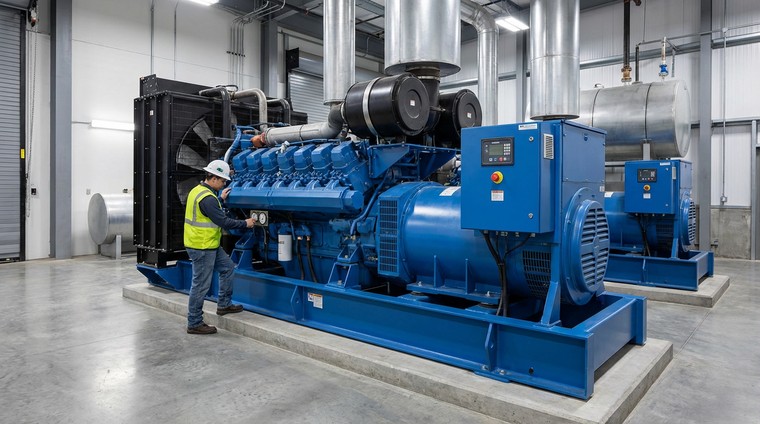
Step-by-Step: How to Do It Better
If you want to ensure your power generation system is bulletproof, follow this workflow:
- Inventory Your Loads: List every piece of equipment. Distinguish between critical loads (must run) and non-essential loads.
- Convert to Amps/kW: Ensure all units are consistent. Remember the formula: kW = (kVA × Power Factor).
- Apply the Sequence of Operation: You don’t need to start everything at once. By using step-loading (starting large motors first), you can often use a smaller, more efficient generator.
- Consult with Tesla Power Experts: Don’t rely solely on online calculators. Real-world variables like altitude and ambient temperature affect engine performance (derating). A Tesla Power consultant can factor these in for you.
Common Questions About Generator Sizing
1. What is the difference between kW and kVA?
kW (Kilowatts) is the actual power used by the equipment to do work. kVA (Kilovolt-Amperes) is the apparent power, which includes both the working power and reactive power. For diesel generators, the standard power factor is 0.8, meaning 100 kVA = 80 kW.
2. Can I just look at my electricity bill to size a generator?
No. Your bill shows average consumption over time (kWh), not the peak instantaneous demand required to start your heaviest machinery.
3. What happens if I oversize my generator?
Running a diesel engine below 30% load causes “wet stacking,” where unburned fuel accumulates in the exhaust system, leading to carbon buildup, reduced efficiency, and potential engine failure.
4. How does altitude affect generator sizing?
Diesel engines need oxygen to burn fuel. At higher altitudes, air is thinner. Typically, you lose about 3.5% of power for every 1,000 feet above 500 feet. You must oversize the engine to compensate.
5. Should I get a single-phase or three-phase generator?
Most industrial facilities require three-phase generators (400V/230V) to run heavy motors efficiently. Single-phase is usually reserved for small commercial or residential use.
Related Posts
What Factors Affect Diesel Generator Fuel Consumption Per Hour?
One of the first questions our clients ask at Tesla Power is, “How much will this cost to run?” It is a valid concern. Over the lifecycle of a diesel generator set, fuel costs often exceed the initial purchase price. However, fuel consumption isn’t a fixed number found in a brochure; it is a variable that fluctuates based on how you use the machine.
Understanding the dynamics of diesel generator fuel consumption allows you to budget accurately, plan fuel storage, and optimize your operational expenses (OpEx). Let’s dive into the mechanics behind the burn rate.
[Insert Image: A close-up graph showing the curve of fuel consumption relative to the percentage of generator load.]
Understanding Specific Fuel Consumption
In the industry, we look at “Specific Fuel Consumption” (SFC). This measures how efficiently the engine turns fuel into electricity. Generally, diesel engines are most efficient when running between 70% and 80% of their rated load. As you deviate from this “sweet spot,” your efficiency drops, and your cost per kilowatt-hour increases.
Primary Factors Influencing Fuel Burn
Why does one 500kW generator burn more than another? Here are the variables:
- Load Percentage: This is the biggest factor. A generator running at 25% load consumes significantly less fuel than one at 100% load, but not linearly. For example, a Tesla Power unit might burn 15 liters/hour at 50% load, but 28 liters/hour at 100% load.
- Engine Design and Age: Modern engines with Common Rail fuel injection and electronic governing systems are far more precise than older mechanical engines. They atomize fuel better, extracting more energy from every drop of diesel fuel.
- Maintenance History: Clogged air filters or dirty fuel injectors starve the engine of oxygen or disrupt the spray pattern. This forces the engine to work harder and burn more fuel to maintain the same power output.
Tools to Monitor and Optimize Consumption
You cannot manage what you do not measure. Here is how to get a grip on your fuel usage:
- Remote Monitoring Systems: Advanced gensets come with telemetry that reports real-time fuel levels and burn rates to your smartphone.
- Flow Meters: Installing high-precision fuel flow meters on the supply and return lines gives you exact data on net consumption.
- Load Management Systems: These systems automatically turn generators on or off based on demand, ensuring engines run at their most efficient load factor.
How to Improve Fuel Efficiency with Tesla Power
To keep your operational costs low, follow these best practices:
First, right-size your generator. As discussed in previous articles, avoiding wet stacking by not running underloaded is crucial. If your load varies wildly, consider a “modular” setup—using two smaller generators synchronized together. You can run one during low demand and both during peaks.
Second, invest in regular maintenance. A well-lubricated engine with clean filters reduces internal friction. Tesla Power maintenance protocols ensure that your engine remains as efficient as the day it was installed.
FAQs on Generator Fuel Economy
1. How do I estimate fuel consumption for my generator?
A general rule of thumb for industrial diesel engines is that they consume approximately 0.07 gallons of fuel per kW per hour at full load. So, a 100 kW generator burns about 7 gallons per hour at 100% load.
2. Does the brand of diesel fuel matter?
Yes. Higher cetane ratings indicate better combustion quality. Also, using “winter blend” diesel in summer can slightly increase consumption due to lower energy density.
3. Can I use biodiesel in my generator?
Many modern generators allow for B5 or B20 biodiesel blends. However, biodiesel has a lower energy content than petroleum diesel, so your volumetric fuel consumption will likely increase slightly.
4. Why is my generator consuming more fuel than the manual says?
This often points to “derating” factors. If you are operating in high temperatures or high altitudes, the engine is less efficient. Alternatively, it could indicate a mechanical issue like a worn fuel pump.
5. Is it better to turn off the generator or let it idle?
Unlike cars, huge diesel generators should not cycle on and off frequently. However, prolonged idling causes wet stacking. If power isn’t needed for more than a few hours, shut it down. For short gaps, keep it running but ensure the load stays above 30%.