
What buyers should know first
Cable size is not only a generator quotation item. It depends on voltage, running current, route length, installation method, ambient temperature, grouping, and the protection device selected by the project electrician.
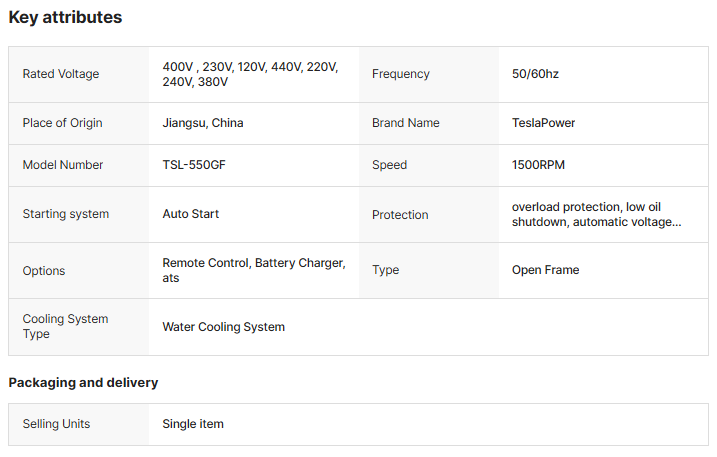
For an RFQ, Yangzhou Tesla Power Equipment Co., Ltd. can quote the diesel generator set and common electrical options, but the final cable schedule should be checked against the site standard and the local electrical code by the project engineer.
Information to send with the inquiry
- Rated voltage and frequency, such as 400V 50Hz or 480V 60Hz.
- Standby or prime duty, expected load percentage, and the largest motor starting load.
- Distance from generator terminals to ATS, switchboard, or distribution panel.
- Cable installation method, including tray, trench, buried duct, or flexible connection.
- Breaker location, cable entry direction, gland plate requirements, and neutral or earthing arrangement.
Common mistakes to avoid
- Do not size the cable only from the generator kVA. Confirm power factor, voltage, derating conditions, and starting current.
- Do not leave the breaker scope unclear. State whether the generator-mounted breaker, outgoing switchboard, ATS, or site panel is responsible for protection.
- Do not ignore cable bending radius and access space. A compact canopy or container may need a clear cable entry drawing before production.
Practical comparison table
| Item to check | Why it matters | What to provide |
|---|---|---|
| Voltage and frequency | Determines current and alternator configuration | Project voltage, phase, 50Hz or 60Hz |
| Route length | Affects voltage drop and cable cost | One-way distance and routing method |
| Breaker scope | Defines protection and quotation boundary | Generator breaker, ATS, or site switchboard |
| Cable entry | Prevents installation delays | Bottom, side, rear, gland plate, or trench entry |
Before requesting a quotation
Send the load list, site single-line diagram if available, target voltage and frequency, cable route distance, and photos of the planned generator location. Ask for a generator outline drawing, alternator data, breaker scope, and terminal arrangement so the electrical contractor can complete the cable calculation.
Questions purchasers often ask
Can the generator supplier decide the final cable size?
The supplier can provide rated current, terminal details, and common guidance. Final cable size should be approved by the project electrician because site route, installation method, and local code control the calculation.
Should cable be included in the diesel generator quotation?
It can be included only when length, specification, installation method, and delivery scope are clear. Many export RFQs keep site power cables outside the generator package.
What cable information is most often missing?
The most common missing details are route length, cable entry direction, breaker location, and whether neutral and earthing conductors are included in the same scope.
Does ATS change the cable plan?
Yes. Cable routes may run from generator to ATS and from ATS to the main panel, so the ATS location and ratings should be confirmed before quotation.
RFQ notes to include
For a clearer quotation, send the site country, voltage and frequency, duty rating, load list, installation layout, control interface requirements, noise or enclosure expectations, and any drawings already approved by the project engineer. Ask the supplier to state assumptions in writing so commercial comparison is based on the same scope.