
You’re staring at generator spec sheets, and the numbers are starting to blur together. 50 kW? 200 kVA? 500 kW? For a purchasing decision that’ll cost tens or hundreds of thousands of dollars and impact your operations for the next 15-20 years, getting the size wrong is expensive—and surprisingly common.
I’ve seen businesses cripple their operations with undersized generators that can’t handle peak loads, and I’ve watched others waste money running oversized units at damaging light loads. At Tesla Power, one of the most frequent questions we field is: “What size diesel generator do I need for my business?” The answer isn’t found in a simple formula—it requires understanding your actual power requirements, load characteristics, and operational profile.
Let’s walk through the sizing process step by step, so you can confidently specify the right generator load capacity for your specific application.\n\n## Why Generator Sizing Matters More Than You Think\n\nBefore we dive into calculations, let’s understand what’s at stake when you get sizing wrong.\n\nUndersizing: The Obvious Problem \nInstall a generator that’s too small, and you’ll experience voltage sags, frequency drops, and potential shutdowns when loads exceed capacity. Motors won’t start properly, electronics may malfunction, and in critical applications like hospitals or data centers, undersizing creates genuine safety risks. You might save money upfront, but you haven’t solved your backup power problem.\n\nOversizing: The Hidden Trap \nHere’s what surprises many buyers: oversizing can be equally problematic. Running a diesel generator set consistently below 30% of rated capacity causes “wet stacking”—unburned fuel accumulates in the exhaust system, fouling injectors and turbochargers. This reduces efficiency, shortens engine life, and increases maintenance costs. Plus, you’ve paid extra for capacity you’re not using.\n\nThe Sweet Spot \nProperly sized commercial generators typically run at 60-80% of rated capacity under normal loads, with enough overhead for occasional peaks. This loading keeps the engine operating efficiently while providing a safety margin for future expansion.\n\n## Understanding Your Power Requirements: The Foundation\n\nSizing starts with understanding what you’re actually powering. This breaks down into three categories:\n\n### Connected Load\n\nList every electrical device and system the generator must power. For each item, you need:\n\n- Running watts: The continuous power draw during normal operation\n- Starting watts: The surge power required when motors and other inductive loads start (typically 2-6× running watts)\n- Priority level: Critical, essential, or optional (more on this later)\n\nDon’t estimate—check equipment nameplates, which display rated power in watts, amps, or horsepower. For three-phase equipment, you’ll calculate: Power (kW) = √3 × Voltage × Current × Power Factor\n\n### Load Profile\n\nHow does your power consumption vary throughout the day and across seasons? A manufacturing facility might see peak loads during production shifts but minimal overnight usage. A data center maintains relatively constant load 24/7. This profile affects whether you need a prime power generator (continuous high load) or a standby generator (intermittent operation).\n\n### Load Type\n\nDifferent loads stress generators differently:\n\n- Resistive loads (heaters, incandescent lighting) draw steady, predictable current with minimal starting surge—easy on generators\n- Inductive loads (motors, transformers, fluorescent lighting) require significant starting current and create reactive power—harder on generators\n- Non-linear loads (computers, variable frequency drives, LED lighting) create harmonic distortion—may require generators with better regulation or higher capacity margins\n\nA facility running mostly computer equipment behaves very differently than one running heavy machinery, even if the nameplate wattage totals are similar.”}]

The Step-by-Step Sizing Methodology
Now let’s get practical. Here’s the systematic approach Tesla Power engineers use to size industrial generators for client facilities.
Step 1: Create a Comprehensive Load Inventory
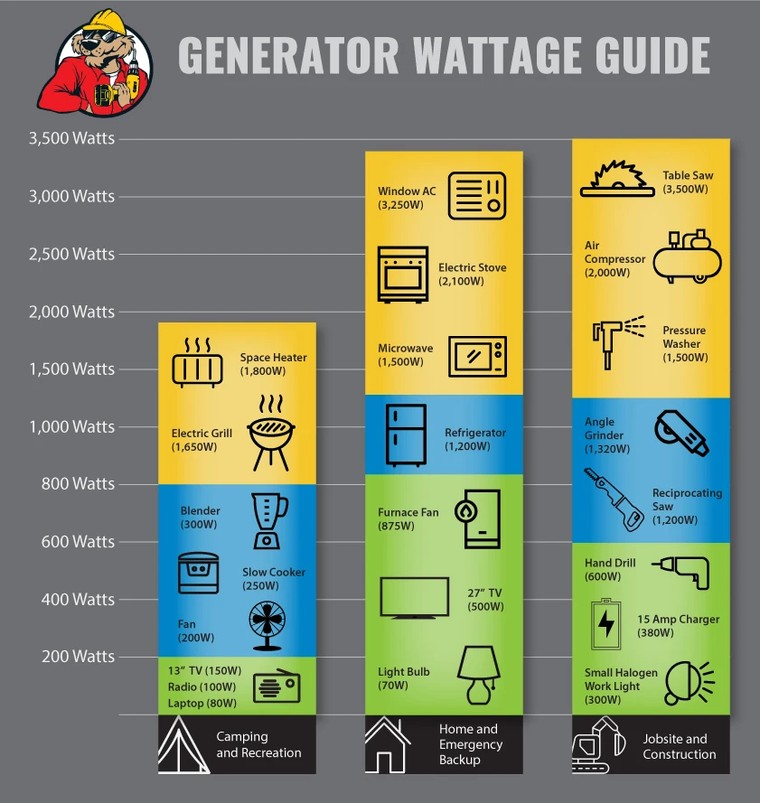
Build a spreadsheet with every electrical load. Here’s a partial example for a small manufacturing facility:
EquipmentQuantityRunning kWStarting kWPriorityNotesCNC Machine21545Critical3× starting surgeAir Compressor (7.5 HP)15.628Critical5× starting surgeHVAC System11236Essential3× starting surgeLighting (LED)—33EssentialMinimal surgeOffice Electronics—88EssentialComputers, serversWelding Equipment11010OptionalResistive loadTotals53.6 kW130 kW
Note that simply adding running watts (53.6 kW) tells you nothing useful—you need to account for starting surges.
Step 2: Calculate Starting Load with Sequential Start Logic
Here’s where many people go wrong: you don’t need to size for every motor starting simultaneously. That almost never happens. Instead, use sequential starting:
- Identify your largest motor starting load
- Add the running loads of everything else that’s already operating
- Apply a diversity factor (typically 0.7-0.8) to account for the statistical unlikelihood of all loads peaking simultaneously
Example calculation:
- Largest starting load: Air compressor = 28 kW
- Running loads of other critical/essential equipment: 15 + 15 + 12 + 3 + 8 = 53 kW
- Total peak demand = 28 + 53 = 81 kW
- Apply 0.75 diversity factor: 81 × 0.75 = 60.75 kW minimum required
For safety margin and efficiency (aiming for 70-75% loading), specify an 80-100 kVA (64-80 kW) generator.
Step 3: Account for Power Factor
Most diesel generator sets are rated in kVA (apparent power), but your loads consume kW (real power). The relationship depends on power factor:
kW = kVA × Power Factor
Typical power factors:
- Resistive loads (heaters): 1.0
- Motor-heavy facilities: 0.7-0.8
- Mixed commercial loads: 0.8-0.85
- Data centers/IT: 0.85-0.95
If your facility has a 0.8 power factor and you need 80 kW, you’ll specify: 80 kW ÷ 0.8 = 100 kVA generator
Step 4: Add Future Expansion Margin
Unless your business is shrinking, plan for growth. Adding 20-25% capacity cushion is standard practice. If today’s calculation shows 100 kVA needed, specifying a 125 kVA unit provides room for additional equipment over the generator’s 15-20 year lifespan.
Just don’t go overboard—remember the wet stacking problems with chronic light loading.
Step 5: Verify Environmental Derating
Manufacturers rate generators at standard conditions (typically 25°C, sea level). If you’re operating in different conditions, you’ll need to derate:
Temperature: Subtract 4% for every 10°C above 25°CAltitude: Subtract 3-4% for every 300m above sea level
Example: If you need 100 kW at 40°C and 1,200m elevation:
- Temperature derate: (40-25)/10 × 4% = 6%
- Altitude derate: 1200/300 × 3.5% = 14%
- Total derate: ~20%
- Required generator rating: 100 kW ÷ 0.8 = 125 kW
Don’t skip this step if you’re in hot or high-altitude locations!
Common Sizing Mistakes to Avoid
Let’s learn from others’ expensive errors:
Mistake #1: Using Online Calculators BlindlyThose “quick generator size calculators” that ask for your square footage? They’re crude approximations at best. A 5,000 sq ft warehouse and a 5,000 sq ft data center have radically different power requirements. Square footage tells you almost nothing about electrical load.
Mistake #2: Sizing for Nameplate RatingsAdding up every nameplate rating assumes everything runs at maximum capacity simultaneously—which rarely happens. A more realistic approach uses measured demand or applies proper diversity factors based on facility type.
Mistake #3: Ignoring Load SequencingYour automatic transfer switch and generator controller can sequence motor starts, preventing simultaneous surge loads. A sophisticated control system can reduce required generator size by 20-30% compared to assuming worst-case simultaneous starts.
Mistake #4: Forgetting About HarmonicsFacilities with heavy non-linear loads (servers, variable speed drives, LED lighting) may need generators oversized by 15-20% or equipped with enhanced regulation to handle harmonic distortion without overheating.
Mistake #5: Not Planning Load SheddingRather than sizing for absolute peak including optional loads, consider automatic load shedding. Your control system can drop non-critical loads during startup, then restore them once essential equipment is online. This strategy often allows a smaller (and less expensive) generator.
Sizing by Industry: Real-World Examples
Different industries have typical sizing patterns. Here’s what we see at Tesla Power across common applications:
Manufacturing Facilities
Typical loads: Large motors (compressors, conveyors, CNC machines), lighting, HVAC, office areasSizing factors: High starting current multiplier (3-5×), poor power factor (0.7-0.8), sequential start criticalRule of thumb: 1.5-2.5 kW per production employee, plus 0.3-0.5 kW per office employeeCommon sizes: 150-500 kVA for small shops, 500 kVA-2 MW for larger facilities
Data Centers
Typical loads: Servers, networking equipment, UPS systems, cooling (CRAC units), lightingSizing factors: High power factor (0.9-0.95), sensitive to harmonics, constant load profileRule of thumb: 1.4-1.6× your IT load to account for cooling and overheadCommon sizes: 500 kVA-3+ MW, often in multiple redundant units (N+1 configuration)
Healthcare Facilities
Typical loads: Life safety systems, elevators, medical equipment, lighting, HVACSizing factors: Stringent code requirements, must power life safety loads within 10 secondsRule of thumb: 8-12 kW per bed for hospitals, 3-5 kW per bed for assisted livingCommon sizes: 500-2,000 kVA for small hospitals, 2-10 MW for large medical centers
Agricultural Operations
Typical loads: Irrigation pumps, grain dryers, refrigeration, livestock ventilationSizing factors: High motor starting loads, often remote locations requiring prime power generatorsRule of thumb: Size for largest pump + 50% of remaining connected loadCommon sizes: 50-200 kVA for farms, 200-500 kVA for processing facilities
Hospitality & Retail
Typical loads: HVAC, lighting, refrigeration, elevators, point-of-sale systemsSizing factors: Mixed load types, code may require emergency and optional loadsRule of thumb: 15-25 watts per square foot for hotels, 10-15 watts per square foot for retailCommon sizes: 100-500 kVA for small hotels, 500 kVA-2 MW for large resorts
Tools and Resources for Generator Sizing
While professional sizing requires expertise, these tools help:
Utility Bill AnalysisYour electricity bills show peak demand (kW) over recent months. This gives you a real-world baseline, though it doesn’t account for starting surges or future growth.
Load Monitoring EquipmentPower quality analyzers or data loggers connected to your electrical panel record actual demand over days or weeks, capturing peak loads and power factor. This data beats theoretical calculations every time.
Manufacturer Sizing SoftwareReputable manufacturers offer sizing tools that account for starting currents, power factor, and load types. Tesla Power provides sizing assistance as part of our consultation process.
Professional Energy AuditFor complex facilities or mission-critical applications, hire a professional electrical engineer to conduct a detailed load study. The few thousand dollars invested prevents hundred-thousand-dollar sizing errors.
Generator Sizing Calculator FormulaFor a quick estimate (not a substitute for detailed analysis):
Required kVA = [(Total Running kW + Largest Motor Starting kW) ÷ Power Factor] × 1.25
The 1.25 multiplier provides 25% expansion margin and accounts for operation in the efficient 75-80% load range.
Making the Final Decision: What Size Diesel Generator Do I Need?
Let’s bring it all together with a systematic decision framework:
1. Document Your LoadsCreate that comprehensive spreadsheet. Include running and starting watts, power factor, and priority level for every load. Don’t guess—measure or check nameplates.
2. Calculate Peak DemandIdentify largest starting load + running loads of simultaneously operating equipment. Apply appropriate diversity factor (0.7-0.8 for most facilities).
3. Convert to Generator RatingDivide your kW requirement by your facility’s power factor to get kVA rating. Add 20-25% margin for future expansion.
4. Apply Environmental DeratingIf you’re operating in hot or high-altitude conditions, upsize accordingly. Don’t skip this step.
5. Consider Load ManagementCan you use sequenced starting or load shedding to reduce peak demand? Modern control systems make this practical.
6. Verify with Professional ReviewFor critical applications or complex facilities, have a professional engineer review your sizing. The cost is negligible compared to the generator investment.
7. Specify CorrectlyMake sure you’re specifying standby generator vs. prime power generator rating appropriately for your intended duty cycle.
Remember: the question “what size diesel generator do I need for my business” has no single universal answer. It depends on your specific loads, operational profile, environmental conditions, and future plans. But armed with the methodology above, you can confidently work with manufacturers like Tesla Power to specify exactly the right size.
Quick Reference: Generator Sizing Cheat Sheet
Application TypeSizing MethodTypical RangeSmall Office/Retail10-15 W/sq ft20-100 kVAManufacturing1.5-2.5 kW/employee150-2000 kVAData Center1.4-1.6× IT load500 kVA-5 MWHospital8-12 kW/bed500 kVA-10 MWAgricultureLargest motor + 50%50-500 kVAHotel/Resort15-25 W/sq ft100 kVA-2 MW
These are rough guidelines only. Detailed load analysis required for actual sizing.
Frequently Asked Questions
Q1: Can I use square footage to determine what size generator I need?Square footage alone is insufficient for accurate sizing. Two buildings of identical size can have vastly different electrical loads depending on their use. A 10,000 sq ft warehouse needs far less power than a 10,000 sq ft data center. Always base sizing on actual electrical loads, not building dimensions.
Q2: Should I size my generator for total connected load or actual demand?Actual demand, not connected load. Unless your facility somehow runs every piece of equipment at maximum capacity simultaneously (which virtually never happens), sizing for total connected load will result in massive and expensive oversizing. Use diversity factors and measured demand data instead.
Q3: What’s the difference between kW and kVA when sizing a generator?kW (kilowatts) measures real power—the actual work your equipment performs. kVA (kilovolt-amperes) measures apparent power, which includes both real and reactive power. Generators are rated in kVA, but your loads consume kW. The relationship depends on your power factor: kW = kVA × Power Factor. Typical industrial facilities have 0.8 power factor, meaning a 100 kVA generator delivers 80 kW usable power.
Q4: How much extra capacity should I add for future expansion?Industry standard is 20-25% above your current calculated needs. This provides room for equipment additions over the generator’s 15-20 year lifespan while keeping you in the efficient 70-80% loading range. Don’t go beyond 30% extra unless you have specific near-term expansion plans—chronic light loading causes maintenance issues.
Q5: Can I save money by buying a smaller generator and using load shedding?Absolutely. Modern control systems can automatically drop non-critical loads during startup, then restore them once priority equipment stabilizes. This strategy often reduces required generator capacity by 15-20%, translating to significant cost savings on both purchase price and fuel consumption. Just ensure your electrician properly classifies loads by priority in your load management system.
Sizing a generator properly requires understanding your specific power needs, load characteristics, and operational environment. At Tesla Power, our engineering team has sized thousands of backup power solutions across every industry. We’re happy to review your facility’s requirements and recommend the optimal diesel generator efficiency solution. Contact us for a professional load analysis and sizing consultation.