
Specify a 60Hz export diesel generator by voltage, duty rating, kW/kVA, load type, alternator, ATS needs, and destination standards.
What buyers should know first
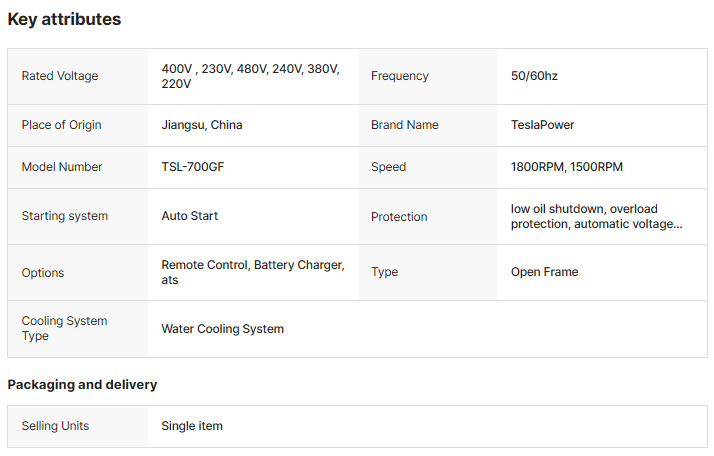
A 60Hz diesel generator should be selected around the destination electrical system, not just the nominal kVA. Industrial projects in 60Hz markets often need 480V, 240V, 208V, or other project-specific voltages, and the alternator, breaker, controller, and protection settings should match that requirement.
Yangzhou Tesla Power Equipment Co., Ltd. can configure diesel generator sets for different frequency and voltage requirements, but the RFQ should clearly state whether the project is standby, prime, open type, silent type, or containerized, and whether ATS or synchronization is required.
60Hz specification points to confirm
| Specification | Why it matters | Practical RFQ wording |
|---|---|---|
| Frequency | Engine speed and alternator output depend on it. | State 60Hz and destination country or site standard. |
| Voltage | Wrong voltage can block installation. | Confirm phase, line voltage, and neutral requirement. |
| Duty rating | Standby and prime outputs are not the same use case. | State runtime pattern and load percentage. |
| Load type | Motors, pumps, and compressors affect starting current. | Send load schedule and start sequence. |
| Control system | Export sites may need ATS, remote alarm, or parallel operation. | List required controller functions and interface signals. |
In practice
The most common export mistake is asking for a 60Hz generator by kVA only. Two projects with the same kVA can need different alternator winding, breaker, canopy, fuel tank, control panel, and documentation. A factory, data center, water-pumping station, and mining workshop may each place different stress on the generator.
For projects with large motors, ask the supplier to review voltage dip and starting method. Star-delta, soft starter, variable frequency drive, and direct-on-line starting can lead to different generator recommendations.
Documents to request
- Technical data sheet showing 60Hz output in kW and kVA.
- Voltage and phase confirmation on the quotation and drawing.
- Engine, alternator, controller, breaker, and canopy descriptions.
- Fuel consumption table at common load points when available.
- Factory test items and packing dimensions for export handling.
Internal references worth checking
Start with 50Hz vs 60Hz diesel generator selection, then compare the output requirement with industrial backup power sizing notes. A related larger-set example is the 800kW 1000kVA Cummins engine diesel generator with ATS option.
Common questions before quotation
Can a 50Hz generator be changed to 60Hz later?
It depends on the engine speed, alternator, controller settings, voltage requirement, and rating. Specify the correct frequency before ordering.
Does 60Hz always mean 480V?
No. Many 60Hz projects use 480V, but other voltages are possible. The buyer should confirm the site voltage and phase arrangement.
What rating should be compared between suppliers?
Compare the same duty rating, voltage, frequency, ambient assumptions, enclosure type, and option list. A standby-only quotation should not be compared directly with a prime-duty configuration.
Should ATS be included in the generator quotation?
If automatic transfer is required, include ATS capacity, pole number, voltage, enclosure, and control logic in the RFQ.
What project limits should be stated?
State altitude, ambient temperature, installation location, noise limit, fuel autonomy, and any shipping or documentation requirements.