
A genset pre-shipment inspection answers three questions: does the machine match the contract and its nameplate, does it perform under load, and is it packed to survive the voyage. Tesla Power Equipment builds these machines and works-tests them, so we sit on the inspected side of the clipboard.
- Independence is the product. The report is worth what the accreditation behind it is worth.
- Scope decides everything. No published inspection checklist includes a running test under load.
- Grades and hold points turn a report into a shipping decision. Without them, findings ship anyway.
- Cost allocation follows the contract, not the inspection body. Silence puts the cost on the buyer.
Why a genset order breaks the standard inspection model
The inspection trade was built around consumer goods: cartons, thousands of units, one inspector for one day. Sampling works at that scale. A genset order inverts it. You buy one to four machines from the export generator set range, each a large share of contract value, and none can be sent back from a remote site.
That is why a genset pre-shipment inspection for one machine is written differently from a carton inspection.
What changes when the lot is one machine
The sampling standard the trade runs on is ISO 2859-1:2026, the third edition, published on 22 January 2026 and running to 82 pages. It replaces the 1999 edition and its amendments. ISO defines the key term plainly: AQL stands for Acceptance Quality Limit, the maximum average percentage of defective items considered acceptable during random sampling.
That definition carries an assumption which does not hold here. An average percentage is meaningful only across a continuing series of lots, and the switching rules between normal, tightened and reduced inspection are built on that same series. A genset order is one to four machines bought once, so there is no series to switch between.
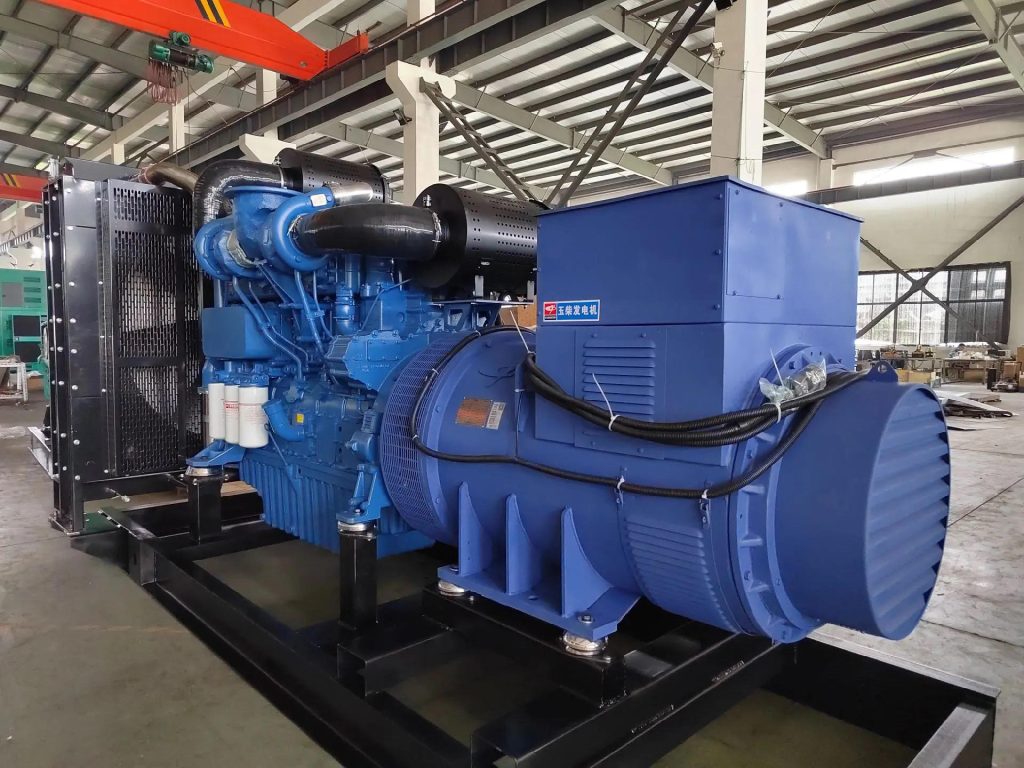
Run the arithmetic on four machines: select two for sampling and half the contract value ships unexamined. Specify 100% inspection plus a witnessed running test on every unit, and put it in writing before you book anyone. Tesla Power asks for that wording at RFQ stage, because sampling is what an inspection quote is usually priced on.
Is your inspection body actually independent?
The third edition of the standard for inspection-body competence and impartiality is ISO/IEC 17020:2026. ISO published it on 27 March 2026 with a corrected version in June 2026, and the 23-page document replaces ISO/IEC 17020:2012, now withdrawn. The change that matters to a buyer is the independence classification: in ISO’s own words, the main change is the simplification of independence categories from three types (A, B and C) to two, Type A and Type non-A.
Three documents settle the question faster than any questionnaire. Ask for the accreditation certificate number and the issuing accreditation body, so it can be checked on a national register. Ask for the written scope of accreditation, because a scope covering textiles does not cover rotating machinery. Ask for a signed conflict-of-interest declaration confirming the fee is not contingent on the outcome. A body that cannot produce all three has answered the question.
Independence is not a brand attribute. It belongs to the legal entity that signs your report, not to the logo on the certificate. A group can hold several legal entities, each with its own accredited scope and its own conflicts. Yangzhou Tesla Power sits on the other side of that relationship, and would rather a buyer named the entity than trusted the logo.
Scope: what to send the inspector before they travel
The scope of work is the whole product. A line reading pre-shipment inspection of two generator sets buys you a report on appearance, quantity and packing, and nothing else. A published inspection body’s criteria may cover type identification, product conformity, safety, function, marking, workmanship, quantity, packaging, unit completeness and compliance with agreed specifications. Ten headings, and two gaps: there is no documentation line and no running test.
So close both gaps in the scope. Gathering documents is not the task, because the shipping documents for export come from the supplier. The task is reconciliation: the technical annex, the proforma invoice and the serial number list checked line by line against the machine. Tesla Power hands an inspector that folder on every order, and a routine genset pre-shipment inspection in China is largely the work of testing the folder against the steel. A buyer asking a China genset supplier for the same folder twice is testing something real.
Static checks in a genset pre-shipment inspection
The cheapest checks happen with the machine cold and silent. You need a torch, a camera and a copy of the technical annex.
Engine serial number, alternator serial number, and controller model with firmware version must agree with each other and with the contract. Photograph each plate close enough to read stamped characters, then step back so plate and machine share a frame. In ISO 8528-5:2022, the edition ISO withdrew on 1 May 2025, rating plates sit in Clause 13.
What surfaces at inspection is usually small drift nobody noticed until a nameplate met an annex. Voltage and frequency are the classic ones: the same model family is built at 50 Hz or 60 Hz, and on a frequency converter set the output frequency is itself a configuration item.
| Field | Why it drifts | How to record it |
|---|---|---|
| Rating definition (PRP / ESP / LTP / COP) | The datasheet quotes a different definition, usually the larger number | Plate photo, citing the annex line that defines the rating |
| Rated output | Quoted at a different power factor or ambient assumption | Plate value verbatim, with units and power factor |
| Voltage, phases, frequency | 50 Hz and 60 Hz variants share one model family | Terminal box and controller configuration screen |
| Controller model and firmware | Substituted during build, and firmware changes menus and language | Boot screen showing model and version |
Ratings language prevents exactly this drift, which is why nameplate data is recorded. ISO 8528-1:2018, third edition, February 2018, states that its classifications are intended to help understanding between manufacturer and customer. Tesla Power Equipment issues one annex per order, and an annex issued by a genset manufacturer against a datasheet drawn from a different rating definition will disagree on paper while agreeing on the machine.
What should the inspector record during a load test?
No published inspection criteria cover this; the standard checklists were written for products without an engine.
The test method is defined in ISO 8528-6:2023, third edition, November 2023, 65 pages, prepared by ISO/TC 70, which specifies the test methods used to characterise an entire generating set. It also provides simulation methods as an alternative for assessing capability against ISO 8528-5, so a witnessed test may be a real load bank run or a simulated one, and the buyer has to state which.
The current edition is ISO 8528-5:2025, the sixth, published in May 2025 and running to 42 pages; ISO withdrew the 2022 edition on 1 May 2025. One widely quoted vendor white paper states its limits as per ISO 8528-5:2018, and another takes its figure from Table 4 of ISO 8528-5:2022.
Both agree on Class G3: steady-state frequency band within ±0.5%, steady-state voltage deviation within ±1%, transient frequency −7% on loading and +10% on unloading, transient voltage −15% on loading and +20% on unloading, frequency recovery within 3 seconds and voltage recovery within 4 seconds. Both are vendor publications rather than ISO text.
Work the load schedule out before test day. Take a set rated 400 kW at 0.8 power factor, which is 500 kVA. Two steps at 50% and 100% of rated output are 200 kW and 400 kW, held for 20 minutes each, giving 40 minutes at load before warm-up and cool-down. If the test bay can only absorb 350 kW, the top step cannot be run at all.
Four things make a witness credible. Instruments with a calibration status printed in the report. Readings photographed at the point of measurement. A test bay able to absorb rated output. A run long enough for temperatures to stabilise. Load bank testing at commissioning and a site acceptance test answer different questions, and Tesla Power keeps those three records separate.
Packing, preservation and loading supervision
Loading is where the published scopes converge. Inspection bodies check the condition of containers and verify the identity and quantity of goods, and the ones that cover minerals and metals recommend loading supervision so the final cargo matches the quantity and quality expected. None of those pages was written for a machine with a serial number, which is the point: loading supervision is a separate line item even where goods are weighed by the tonne.
Piece count is easier to agree in advance than to argue about on the quay. Work out how many generator sets fit in a 40 ft container for your machine and make that the number the inspector verifies. Require the report to record piece count and identity of every item, container and seal number photographed, interior condition before loading, and photographs at roughly half loaded.
- Desiccant and vapour barrier fitted, with the date of the last inspection noted.
- Batteries disconnected and terminals protected against accidental contact.
- Residual fuel and coolant drawn down to the carrier’s requirements.
- Lifting points visible, marked and free of the weather wrapping.
Our own sequence for lifting and packing is the one we ask inspectors to work from, and it is worth sending yours to the inspection body before it quotes. Tesla Power treats a packing list for a genset for export as part of the contract annex.
What actually holds a shipment when a finding is raised?
A report has no legal force of its own. It binds because the contract says what happens next, and most contracts say nothing. A genset pre-shipment inspection for capital equipment belongs in the order, not added afterwards. Two concepts belong in the contract: the defect grade and the hold point.
Critical, major and minor, redefined for capital equipment
The grades are standard vocabulary, but the consumer definitions do not transfer. A wrong engine model is major on a retail product; on a generator set it is critical, because the set cannot deliver its contracted rated output and the nameplate is wrong.
| Grade | Definition for a generator set | Contract consequence |
|---|---|---|
| Critical | Affects safety, prevents compliance with the declared standard, or stops the set delivering its contracted rated output | Hold. No release without the buyer’s written acceptance of a stated remedy |
| Major | Affects availability or serviceability but is rectifiable at destination without changing the rating | Ship only against a written rectification plan with dates and parts |
| Minor | Appearance, finish or documentation completeness, with no effect on function or rating | Ship, with the item tracked on a punch list and a close-out date |
Grading is a judgement, so require every finding to cite the clause it conflicts with. That turns an opinion into a defect with a reference.
Where the contract is silent, the cost lands on whoever is most exposed: the buyer. The wording that matters is the difference between a hold point and an observation. A hold point means the seller cannot ship until you release in writing; an observation means the goods ship and the finding is noted. Tesla Power prefers the first wording: it forces the remedy into the open before the container is sealed.
Can a video inspection replace sending an inspector?
Partly. Remote witnessing works where verification is visual and the object is stationary. It fails where the inspector must measure with their own instrument.
- Remotely: nameplate and serial numbers with plate and machine in one frame; document reconciliation on a shared screen; external condition on a walk-round the inspector directs; packing, piece count and seal number as continuous video.
- Not remotely: insulation resistance, readings under load, and sound pressure. All three need the inspector’s own calibrated instrument at the point of test.
The video has to be live and continuous, and the scope must name which items you release to remote verification. A recorded clip proves what happened once; a live feed lets the inspector ask for a second angle.
The clause to put in your purchase contract
Everything above collapses into one clause. Raise it first as the inspection clause in the RFQ, before price is agreed, because it changes what suppliers budget for.
- The Buyer may appoint a body accredited to ISO/IEC 17020 to inspect the Goods before shipment.
- The Supplier shall grant access to the works, the test bay and the relevant records.
- That body shall first provide its accreditation certificate number and issuing accreditation body.
- It shall also provide its written scope of accreditation and a signed conflict-of-interest declaration.
- Scope: type identification, conformity with the technical annex, nameplate and serial number verification, unit completeness, workmanship, packing and loading supervision.
- Inspection covers 100% of the units; attribute sampling is not accepted.
- A Critical finding is a hold point: the unit shall not ship without the Buyer’s written release.
Do not expect the trade term to settle it. Incoterms 2020 rules, first published by the ICC in 1936 and in force since 1 January 2020, are eleven three-letter terms clarifying the tasks, costs and risks of delivering goods. They allocate delivery risk, not an inspection right. Conformity assessment for the EU market adds a documentation layer on top, and the same annex has to carry it.
Frequently asked questions
What is the difference between a third-party inspection and the factory’s own test report?
Independence, not the number of tests. Factory testing produces the engineering evidence, and its criteria belong to the manufacturer and the contract. An inspector witnesses that work and checks the machine against the contract. Competence and impartiality sit in ISO/IEC 17020, while test methods sit in ISO 8528-6.
Can I use AQL sampling for a generator set order?
It is a poor fit, for structural reasons. ISO 2859-1 defines the acceptance quality limit as the maximum average percentage of defective items acceptable during random sampling, and its switching rules presuppose a continuing series of lots. One to four machines bought once is not a series, so specify full inspection of every unit.
What changed in ISO/IEC 17020 in 2026, and does it affect my existing contract?
ISO published the third edition on 27 March 2026, with a corrected version in June 2026. It runs to 23 pages and replaces ISO/IEC 17020:2012, now withdrawn. The main change is the simplification of independence categories from three types (A, B and C) to two: Type A and Type non-A. A clause requiring a Type C body should be reworded at the next amendment.
Does ISO 8528 define a factory acceptance test?
No. Factory acceptance test is not a term in the ISO 8528 series; it is an industry convention rather than a standard-defined activity. The series supplies test methods. ISO 8528-6:2023 specifies the methods used to characterise a generating set and puts responsibility on the manufacturer for specifying the tests, so the contract has to define what gets run.
How long should the witnessed load test run, and at what load?
Nothing sets a duration for a pre-shipment inspection, and nothing obliges the supplier to run one unless the contract says so. ISO 8528-6:2023 governs the method and permits simulation as an alternative to a real load bank, so silence defaults to whatever the factory already does. Agree the load steps, dwell time, readings and calibration in writing.
Who pays for re-inspection if the first inspection fails?
Whoever the contract says, and if it is silent, in practice the buyer. Split it three ways before ordering. First inspection at the buyer’s cost, whether or not it passes. Rework and the re-inspection visit at the supplier’s cost where the finding is theirs. Vessel delay charges follow the party responsible for the hold.
What should I do if a critical finding is raised two days before cut-off?
That depends on a distinction which should already be in the contract. If a critical finding creates a hold point, the supplier has no right to ship without written release, and the cut-off stops being the buyer’s problem alone. If it is only an observation, the goods ship and the finding is recorded.
One check is worth doing this week, before any inspection is ordered. Open your current purchase contract template and search for Type C. If it is there, the clause was written against an edition of ISO/IEC 17020 that ISO has withdrawn, and it will not read the way it was intended when it is tested. Ask our export desk for the annex we work from, and Tesla Power will walk your scope line by line before you book an inspector.