
A 40ft high cube carries 28,600 kg. A Cummins C500 D5 in an acoustic canopy weighs 5,281 kg with fluids. Divide one by the other: five. Load the box and you will fit two.
How many generators fit in a 40ft container is decided by payload and door aperture — two limits that rarely bind together. A 40ft high cube gives 28,600 kg of payload and a 2,340 × 2,577 mm door opening. Mid-range sets run out of floor length first. Above about 1,400 kVA they stop fitting at all.
- Payload is 28,600 kg; two canopy 500 kVA sets use 10,562 kg.
- Door width is 2,340 mm — 10 mm narrower than the box interior.
- The same 500 kVA model ships six per box on a skid, two in a canopy.
- A 1,500 kVA containerised set is 12,192 × 2,438 × 2,896 mm — a 40ft high cube itself.
- Exceeding in-gauge limits is not banned — just reclassified, plus USD 500.
Why is “how many fit” a weight problem and a space problem at once?
Every container load calculator online was built for cartons: take the box volume, take the carton volume, divide. A generator set defeats that three ways, and a plan has to survive all three. The first is mass — a 40ft high cube offers 28,600 kg of payload on Hapag-Lloyd’s figures and 28,620 kg on Maersk’s, and no stacking adds a kilogram. The second is the door: 2,340 mm wide and 2,577 mm high on a high cube, against an internal width of 2,350 mm and an internal height of 2,697 mm, so anything wider than the door never gets in. The third is the floor — 12,032 mm by 2,350 mm, and a genset is a long rigid box that neither stacks nor tilts. Your answer is the smallest number the three produce. Enclosure type moves all three at once, so settle the open-frame versus silent canopy choice before you fix a count. It changes again the moment you choose a canopy.
Door 2,340 x 2,577 mm
Clears by 131 mm
Door 2,340 x 2,274 mm
Fails by 172 mm
What are the real internal dimensions of a 40ft high cube?
Both 40ft boxes share a floor — 12,032 mm by 2,350 mm inside, 32,500 kg maximum gross weight — whether you book a 40ft standard (ISO 42G1) or a high cube (45G1). Everything else differs, and not as buyers expect.
| Specification | 40ft Standard (42G1) | 40ft High Cube (45G1) |
|---|---|---|
| Internal length | 12,032 mm | 12,032 mm |
| Internal width | 2,350 mm | 2,350 mm |
| Internal height | 2,393 mm to load line* | 2,697 mm to load line* |
| Door opening (W × H) | 2,340 × 2,274 mm* | 2,340 × 2,577 mm* |
| Maximum gross weight | 32,500 kg | 32,500 kg |
| Tare | 3,700 kg* | 3,880 kg* |
| Maximum payload | 28,800 kg* | 28,620 kg* |
* Maersk figures. Hapag-Lloyd publishes 2,395 / 2,700 mm internal height, 2,292 / 2,597 mm door height and 28,750 / 28,600 kg payload; this article takes the tighter number. The standard box carries 150–180 kg more, because it weighs less empty — a high cube buys 303 mm of extra door height. Sources: Maersk (PDF), Hapag-Lloyd.
Why is the door opening narrower than the container?
The usable opening is the door, not the interior — and it is smaller both ways.
Door width: 2,340 mm against an internal 2,350 mm
Maersk and Hapag-Lloyd both publish 2,340 mm of door width on 40ft dry boxes, against a 2,350 mm internal width. The door is 10 mm narrower than the box. A canopied or skid-mounted genset is rigid: it cannot be squeezed through a gap. Anything over 2,340 mm wide does not go in.
Door height: design against 2,577 mm, not 2,697 mm
The height gap is far larger. A high cube is 2,697 mm tall inside to the load line, but its door is 2,577 mm — 120 mm shorter. Use 2,577 mm: Hapag-Lloyd lists 2,597 mm for the same box, so a unit between the two may clear one fleet and fail another. A 40ft standard door is just 2,274 mm — a C500 D5 canopy stands 2,446 mm, 172 mm over it; the open skid at 2,266 mm clears by 8 mm.
What do generator sets actually measure?
Published figures for named models, not typical values for a power band. Weights are wet — fluids in radiator and sump, fuel tank empty. The last column is an arithmetic ceiling: payload ÷ wet weight, then length and width, taking the smallest.
| Model (50 Hz) | Rating | Open skid — L×W×H mm, wet kg | Canopy — L×W×H mm, wet kg | Per 40ft HC |
|---|---|---|---|---|
| Cummins C275 D5 | 275 kVA ESP | 3,086 × 1,360 × 2,017.8 — 3,357 | 4,259 × 1,424 × 2,315 — 4,611 | 3 / 2 |
| Cummins C500 D5 | 500 kVA ESP | 3,686 × 1,160 × 2,266 — 4,053 | 5,093 × 1,564 × 2,446 — 5,281 | 6 / 2 |
| Cummins C1000 D5 | 1,041 kVA ESP | 4,302 × 1,702 × 2,139 — 6,520 | Not published | 2 / — |
| Cummins C1400 D5 | 1,400 kVA ESP | 5,143 × 2,000 × 2,518 — 10,069 | Not published | 2 / — |
| Cummins C2000 D5 | 2,063 kVA ESP | 6,175 × 2,286 × 2,537 — 17,147 | Not published | 1 / — |
Per-40ft-HC figures: open skid first, canopy second. Sources: Cummins data sheets per model — C500 D5, C1400 D5 (DS44-CPGK), C2000 D5 (DS48-CPGK).
ESP, PRP, and why the model number matters
Data sheets print two ratings: ESP (standby, the higher figure) and PRP (prime, the lower continuous one). The Cummins C500 D5 is rated 500 kVA ESP, with a lower PRP figure; the C550 D5 is 550 kVA ESP at 500 kVA PRP — two machines, two footprints, both sold as “500 kVA”. The rating definition is what creates that gap — see prime versus standby generator ratings. At 0.8 power factor, 500 kVA is 400 kW.
Worked example: how many 500 kVA sets fit?
Take the Cummins C500 D5 in its canopy: 5,093 mm long, 1,564 mm wide, 2,446 mm tall, 5,281 kg wet.
Step 1 — payload says five
28,600 ÷ 5,281 = 5.41, so five: 5 × 5,281 = 26,405 kg, inside the payload; six would be 31,686 kg. The door is no obstacle — 1,564 mm against 2,340 mm, 2,446 mm against 2,577 mm. But that height also rules out a 40ft standard box, whose door is 2,274 mm, 172 mm lower.
Step 2 — the floor says two
Length: 12,032 ÷ 5,093 = 2.36, so two end to end — 2 × 5,093 = 10,186 mm, leaving 1,846 mm unused. Width: 2 × 1,564 = 3,128 mm exceeds the 2,350 mm interior, so one across. Two by one is two. The smallest of three limits wins: 10,562 kg, 37% of the payload.
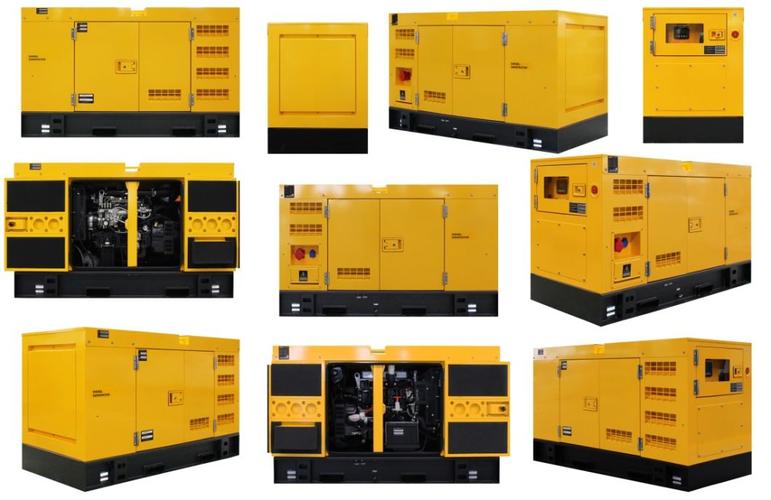
Now drop the canopy. The same Cummins C500 D5 on an open skid is 3,686 × 1,160 × 2,266 mm and 4,053 kg wet. Payload alone allows seven units, since 7 × 4,053 = 28,371 kg against 28,600 kg. The floor allows three along the length — 3 × 3,686 = 11,058 mm of the 12,032 mm available — and two across the width, since 2 × 1,160 = 2,320 mm against 2,350 mm. Three by two is six, and six is under the payload ceiling of seven, so the answer is six: 24,318 kg and 58 m³ of the 76 m³ box. Same engine, same alternator, same datasheet rating — the enclosure costs four units out of six. Treat six as a ceiling: total lateral slack is 30 mm before dunnage. For the enclosure formats this applies to, see our containerized generator set guide. Compare the enclosure options.
When does weight stop you before the floor does?
Below about 500 kVA the floor binds first and payload is a limit you never reach. Past roughly 1,250 kVA it reverses, because mass grows faster than footprint on the large-bore engines. The Cummins C1400 D5 (1,400 kVA ESP, 10,069 kg wet) gives two per box on both counts; the Cummins C2000 D5 (2,063 kVA ESP) with a remote radiator would fit two by length but two weigh 31,560 kg — 2,960 kg over payload, so weight wins and the answer is one.
What happens at 1,500 kVA — when the generator is the container
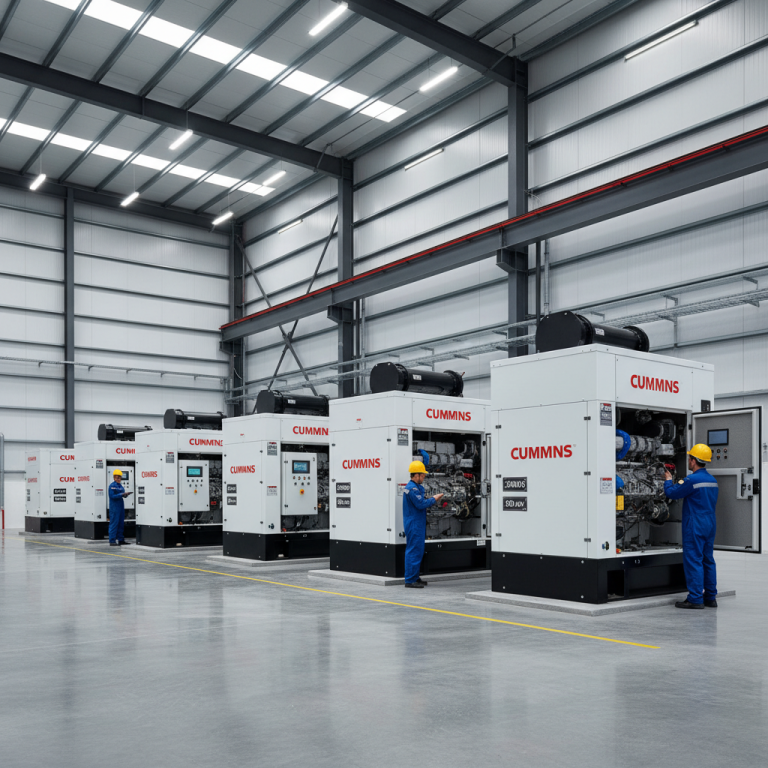
Here is the fact that reorganises the whole question. The Himoinsa HTW-1530 T5 (1,500 kVA PRP / 1,650 kVA ESP) is published at 12,192 × 2,438 × 2,896 mm and 20,745 kg with liquids in radiator and sump. Those are 40 feet, 8 feet and 9 feet 6 inches — the external dimensions of a 40ft high cube. It is not packed into a container; it is built to the dimensions of one.
The proof is in the internal length, and it is a proof rather than an opinion because both numbers are published. A 40ft high cube measures 12,032 mm inside; the Himoinsa HTW-1530 T5 is 12,192 mm long, which makes it 160 mm too long to go inside one. It is also 2,438 mm wide against a 2,340 mm door — 98 mm too wide — and 2,896 mm tall against a 2,577 mm door, 319 mm too tall. All three of its dimensions fail independently, and the length is the one that nobody can argue with: you simply cannot shorten a monocoque container shell. At this rating there is no load plan left to optimise, because the set has stopped being cargo and travels as a shipping unit in its own right, on its own corner castings.
The payload headroom you cannot spend
Weight is not the problem at all. At 20,745 kg the HTW-1530 T5 sits 7,855 kg under the 28,600 kg payload of a 40ft high cube: room for it in mass terms, none in any other. Whether it can be handled as an ISO container depends on its CSC plate.
What if it will not fit? Open top and flat rack
When a set exceeds a dry box, the options are different equipment under different rules. Maersk accepts these as in-gauge:
- 40′ Open Top — 1,181 × 219 × 234 cm, 28,600 kg
- 40′ Open Top High Cube — 1,181 × 219 × 265 cm, 28,600 kg
- 40′ Flat Rack — 1,163 × 244 × 194 cm, 34,500 kg
- 40′ Flat Rack High Cube — 1,163 × 244 × 226 cm, 34,500 kg
Source: Maersk, Out of Gauge cargo. Note the width: 219 cm on open tops is narrower than a dry box’s 2,340 mm door. Treat the table as a commercial threshold — Hapag-Lloyd lists a 40ft open top high cube at 12,029 × 2,352 × 2,649 mm internally; flat rack gross weight comes in two classes, 45,000 kg and 52,500 kg.
What a misdeclaration costs
Any discrepancy in a special cargo declaration results in the shipment being treated as out of gauge. The carrier may charge additional freight, handling charges and a Misdeclaration Fee of USD 500, and terminals can refuse to load cargo whose dimensions do not match.
Securing: what gets a load plan rejected
Securing is where good plans die. Per the Maersk Line Lashing Guide, lashing eyes on flat racks are rated at 5,000 kg and are the weakest link — the eye, not the strap, sets the number of lashings. Maximum securing load is 50% of breaking load. Wood dunnage must sit between metal cargo and the bottom rails, and over-width cargo must not be stowed within 30 cm of the front end.
Frequently asked questions
How many 500 kVA generators fit in a 40ft container?
Using the Cummins C500 D5: two in a canopy, up to six on an open skid. Payload allows five canopy sets (26,405 kg of 28,600 kg), but each is 5,093 × 1,564 mm — two end to end, one across. The open skid is 3,686 × 1,160 mm: three by two.
Can a generator wider than 2,340 mm go into a 40ft container?
No. Maersk and Hapag-Lloyd both publish 2,340 mm of door width on 40ft dry boxes, and a rigid machine cannot be flexed through a gap. Internal width is 2,350 mm, but you never reach those 10 mm. A wider set needs an open top, a flat rack, or an out-of-gauge booking.
Is a 40ft high cube always the better choice for a generator set?
Nearly always, but for height rather than capacity. The high cube door is 2,577 mm against the standard box’s 2,274 mm. A C500 D5 canopy stands 2,446 mm, clearing a high cube and missing a standard door by 172 mm. The standard box does carry 150–180 kg more payload.
Do I need special equipment for a 2,000 kVA class set?
Usually. The Cummins C2000 D5 (2,063 kVA ESP, data sheet DS48-CPGK) with a set-mounted radiator is 6,175 × 2,286 × 2,537 mm: two end to end need 12,350 mm against 12,032 mm of floor, so one per box. And 2,286 mm exceeds the 2,190 mm in-gauge width Maersk publishes for open tops.
Does a 1,500 kVA containerised genset ship inside another container?
No. The Himoinsa HTW-1530 T5 is published at 12,192 × 2,438 × 2,896 mm — the external dimensions of a 40ft high cube. A 40ft high cube is 12,032 mm long inside, so the set is 160 mm too long to go into one. It ships as a container in its own right.
What is the fastest way to check a supplier’s load plan?
Ask for the data sheet page with the dimension drawing and the wet weight, then divide payload by wet weight, internal length by unit length and internal width by unit width. Take the smallest result, and check width against 2,340 mm first.
Before you accept the next freight quote
Three numbers settle almost every load plan: 2,340 mm of door width, 2,577 mm of door height and 28,600 kg of payload. Run your machine against all three and take the smallest result — you will know the answer before your forwarder does. The two failures that cost most: the canopy that misses a standard box door, and the 1,500 kVA set that is already the container.
Freight is quoted per box, so the fewer kVA you load, the more you pay per kVA. Drewry’s World Container Index put Shanghai–Rotterdam at US$3,997 per 40ft container (assessment dated 10 September 2026). Six open C500 D5 skids put 3,000 kVA in one box — US$1.33 per kVA; two canopy units put 1,000 kVA in the same box for the same money, US$4.00. Three times the freight per kVA for the same machine. Freightos put the same lane at US$4,373 in early September 2026; both are spot rates for one week, not contract rates. Import duty and landed cost for generator sets breaks those charges down line by line. Ask what a set costs per kVA landed.
Send us your model list and destination and we will return a load plan with the arithmetic shown — payload, floor tiling and door clearance per unit, plus the freight cost per kVA. Send us the rating and destination and we will return a packing plan and a quote built on those numbers. Ask for a load plan with your quotation.