
Telecom tower diesel generator RFQ checks for remote backup power, ATS, fuel autonomy, enclosure choice, voltage, and maintenance access.
What buyers should know first
A telecom tower backup generator is usually selected for reliability, automatic starting, fuel autonomy, and service access rather than for maximum output alone. The load may be modest, but a remote site can be costly to revisit if the voltage, frequency, fuel tank, enclosure, or controller does not match the project.
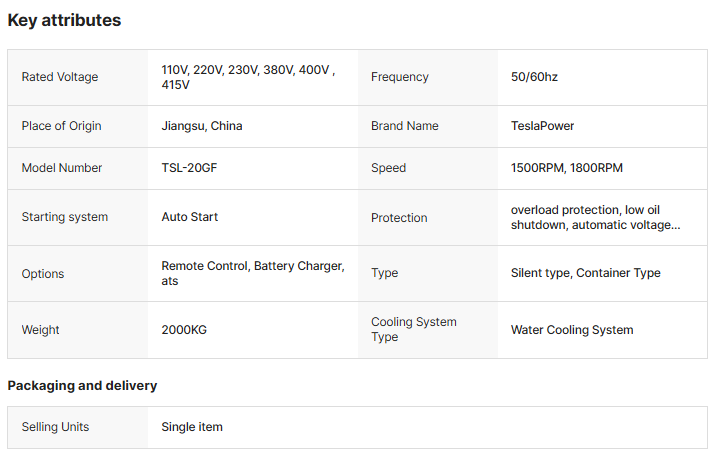
For Yangzhou Tesla Power Equipment Co., Ltd. to quote a practical configuration, the purchaser should state the telecom load, rectifier or battery-system input, required backup hours, site altitude and temperature, and whether the generator must work with an ATS or existing DC power system.
Key decisions for telecom tower backup
| Decision | Typical concern | RFQ detail to confirm |
|---|---|---|
| Output range | Undersizing affects charging and site uptime. | Running kW/kVA plus future expansion allowance. |
| Auto-start control | Unattended sites need reliable start logic. | ATS signal, controller model, and alarm contacts. |
| Fuel autonomy | Remote refueling can be difficult during outages. | Required backup hours and load percentage. |
| Enclosure | Weather, dust, noise, and vandalism matter. | Silent canopy, base tank, locks, and ventilation needs. |
| Maintenance access | Small compounds can restrict service work. | Site layout, access path, and lifting constraints. |
In practice
Many telecom RFQs mention only kVA and price. That is not enough for a remote tower site. A set that starts correctly in a factory test may still fail to satisfy the project if the fuel tank is too small, the control interface is unclear, the canopy cannot handle dust and heat, or the service doors cannot open inside the compound.
If the tower uses batteries, confirm whether the generator is intended to recharge batteries, support the full site load, or both. The charging profile can change the expected load and runtime calculation.
Before requesting a quotation
- Confirm AC load, rectifier input, phase, voltage, and frequency.
- State required backup hours at realistic load, not only tank volume.
- Confirm whether the site needs a silent set, weatherproof canopy, or compact footprint.
- Request controller alarm outputs and remote monitoring compatibility if needed.
- Ask for service-clearance dimensions and fuel filling location.
Internal references worth checking
For automatic operation, review automatic transfer switch requirements for diesel generators. For acoustic questions near communities or roadside sites, see the silent diesel generator noise level guide. A compact related product example is the 20kW Cummins silent diesel generator set with ATS option.
Common questions before quotation
Is a small telecom generator always cheaper to operate?
Not necessarily. Light-load operation, poor maintenance access, or frequent service visits can raise project cost. Match output to the actual load and autonomy target.
Should the fuel tank be sized by hours or liters?
Hours at a defined load is clearer. Tank volume alone does not show runtime unless the load and fuel consumption assumptions are known.
Does every telecom site need a silent canopy?
No, but silent or soundproof sets are often preferred near residential areas, offices, or locations with night-time noise restrictions.
What should be checked for remote start?
Confirm start signal, battery charger, block heater if needed, alarm contacts, controller language, and how the system handles failed-start alarms.
Can the generator charge telecom batteries directly?
The generator normally supplies AC power to the site power system or rectifier. The electrical interface should be confirmed with the telecom power-system designer.