
A diesel generator maintenance checklist for export projects is fixed at order stage, not at commissioning. Interval, spares and records are decided before the set ships, because the site may sit thousands of kilometres from the nearest engine service network. Tesla Power Equipment builds the sets and writes the interval table with the buyer.
- The interval is a contract term. Oil, filter and coolant intervals are quoted in running hours and in calendar months, and the shorter of the two governs.
- Spares travel with the set. A filter kit that costs little when the machine is built costs a month of downtime when it has to be imported separately.
- Records decide warranty claims. An engine service network asks for the logbook before it opens a claim, not after.
- Duty changes everything. A standby set and a prime-power set on the same engine do not share an interval, and the site planning notes set out the difference.
Why a diesel generator maintenance checklist is fixed at order stage
Most premature generator failures are not manufacturing defects. They come from missed service intervals, contaminated fuel, loose electrical connections and neglected cooling systems. On an export project those causes are amplified, because the person who signs the order is rarely the person who runs the machine. A 1,000 kW set on a remote mine can lose a week of production to a filter that costs less than its own freight.
The commercial argument is straightforward: a filter set and a drum of the correct oil cost a fraction of one day of lost output at a mine, a hospital or a data hall. The same parts protect the two most expensive assemblies in the set, the engine and the alternator. A replacement alternator for a 400 V machine can take six weeks to arrive, and the site carries the downtime in the meantime.
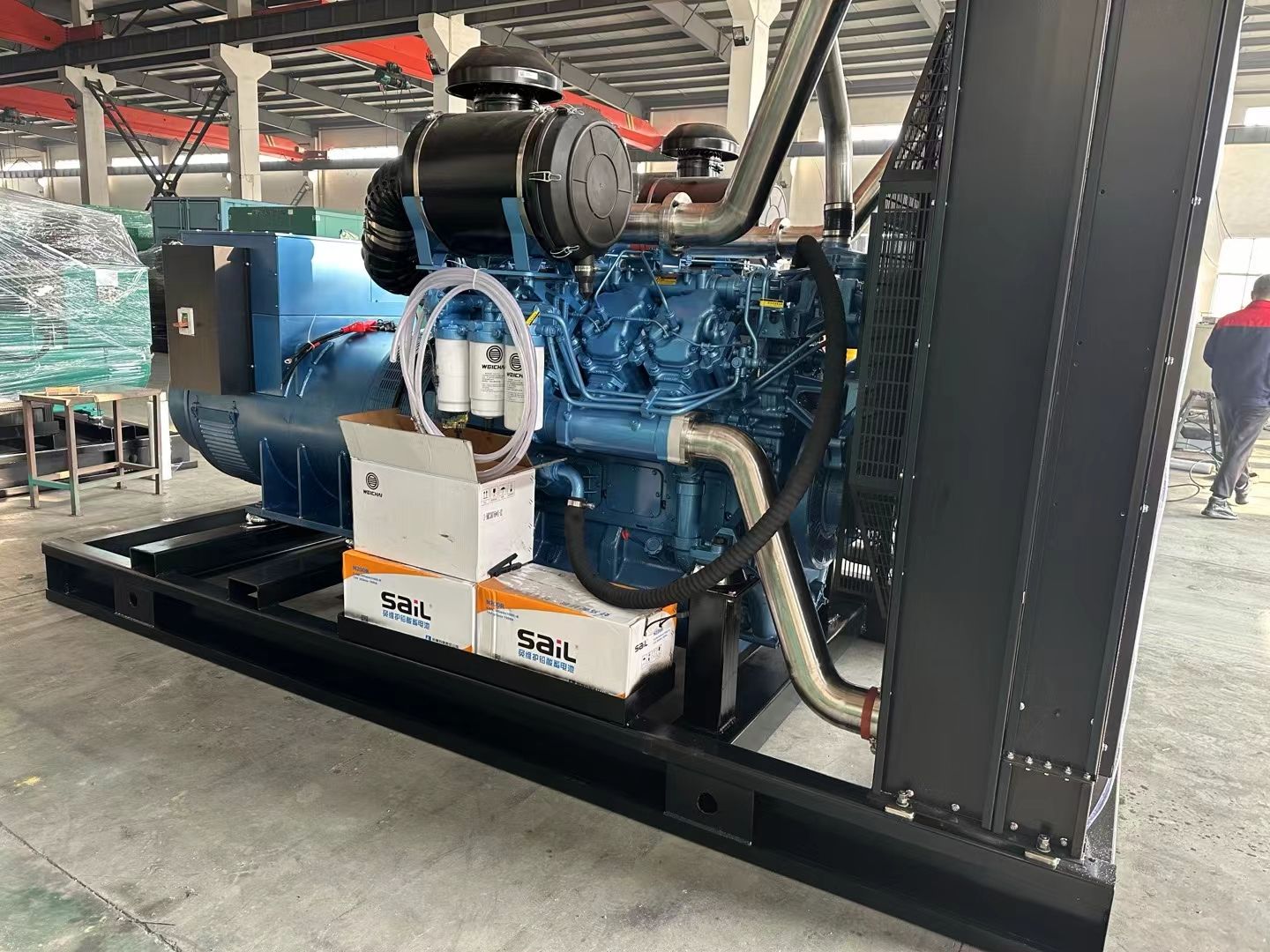
What does the ISO 8528-1 duty rating change about the interval?
ISO 8528-1 separates generator set ratings by how many hours a year the machine is expected to run, and that classification moves the service interval further than any other variable. Prime power is defined for unlimited annual hours, with a 24-hour average load no higher than 70% of the rating. Limited-time running power is capped at 500 hours a year. Emergency standby power is capped at 200 hours a year.
The practical rule is to ask what the set will do, not what the quotation calls it. A hospital set that tests for thirty minutes a month and covers two outages a year runs under 100 hours, while the same frame size in a quarry running a crusher eight hours a day runs over 2,000 hours. Both are legitimate purchases, and both need a different interval table and a different spare kit. Tesla Power records the duty class on the order acknowledgement, so the 50 Hz schedule that follows matches the application.
Daily checks before every start
Daily checks are the cheapest item on the list and the one most often skipped when a set runs unattended. They take under ten minutes and they catch the four failures behind most unplanned outages: no fuel, low oil, low coolant and a flat battery. On an export site the battery is the weakest link, because a 24 V lead-acid bank that is never load-tested reads a healthy voltage right up to the morning it fails to crank. The export generator sets we build are supplied with the daily sheet already translated.
- Fuel level and water trap. Drain any water or sediment from the pre-filter bowl and record the volume.
- Lube oil level. Read the dipstick between the minimum and maximum marks with the engine stopped.
- Coolant level. Check the expansion tank window cold, because topping up with raw water dilutes the inhibitor.
- Battery voltage. On a 24 V system, look for more than 25.2 V at rest.
- Leaks and alarms. Any oil, fuel or coolant under the base frame is a stop before start.
Monthly and quarterly checks
Monthly work is where the set proves it can still carry load. A no-load run brings the engine up to temperature but exercises almost nothing else, and it does not burn off the condensation that collects in the exhaust and the crankcase. The monthly routine should therefore be a loaded run, with the transfer sequence tested at the same time so that the switchgear is proven alongside the engine. Quarterly work adds the mechanical items that are easy to defer and expensive to miss.
| Interval | Item | What it protects |
|---|---|---|
| Every start | Fuel, water trap, lube oil, coolant, battery, alarms | The four most common no-start and shutdown causes |
| Monthly | 30 minutes on load, transfer test, charger output, exhaust colour | Proves the set carries load, not only that it starts |
| Quarterly | Belt tension, air filter restriction, terminal torque, exhaust joints | Catches slow degradation before it becomes a shutdown |
| Annual or 500 hours | Oil and all filters, valve clearances, coolant inhibitor, load bank test | Resets the wear clock and confirms output at site voltage |
| Five years | Coolant renewal, hoses, vibration mounts, insulation test | Addresses age-related failures hours alone will not show |
The annual service and the load bank test
The annual service is the point where the set is measured rather than inspected. Engine oil and all filters are replaced regardless of running hours, because oil oxidises with time as well as with use. Valve clearances are checked against the engine manufacturer’s specification, and the coolant is tested for inhibitor concentration and renewed if it has drifted out of range. The load bank test is the item export buyers most often drop to save cost, and it is the one that proves the set still delivers its rating at 400 V or 480 V.
An engine that has never been run above 40% load can develop wet stacking, unburned fuel and carbon in the exhaust. For a set fitted with an electronic control module, the annual service should also include reading the stored fault history. Where the set serves an emergency load, the site test routine is usually written around NFPA 110, which is a question for the installation rather than the machine.
The same visit is the moment to check the spare kit against the consumption actually logged, because a filter that runs out three months before the next shipment is a shutdown waiting to happen. The spare parts and maintenance document checks list what a complete kit contains.
How many hours between oil changes on an export set?
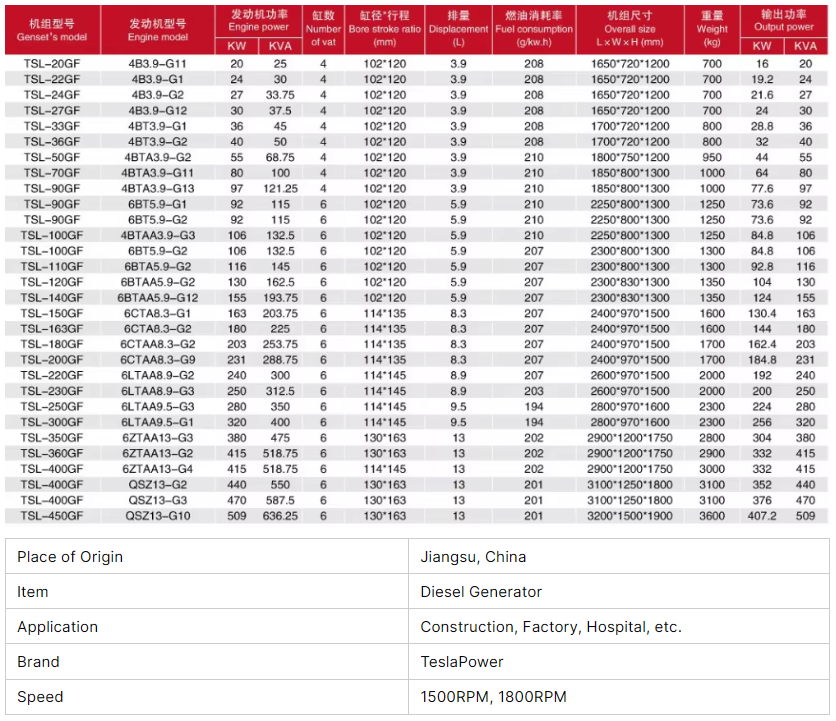
Hours are the honest unit, but most export sites are not run on hours. Take a 160 kW / 200 kVA set at 0.8 pf, the interval Tesla Power quotes for normal duty at 500 running hours. On prime power at eight hours a day, five days a week, the set runs 8 × 5 × 52 = 2,080 hours a year. Dividing by 500 gives 2,080 ÷ 500 = 4.16 services a year, which rounds up to five: four triggered by the hour meter and one by the calendar.
On standby duty at 250 hours a year the same interval stretches to two calendar years before the hour count is reached, so the calendar sets the service date rather than the meter. That difference is why the interval table has to be written for the duty, and why an operator who resets the hour meter at commissioning destroys the only evidence that the schedule ever ran. Fuel quality and dust load shift the number again, and a site drawing from a road-tanker fill in a dusty environment should shorten the filter interval.
Which spare parts belong in the shipping container?
Spares are cheap at the factory and expensive everywhere else. The rule for an export order is to ship one full service kit plus the parts whose failure stops the set, and to ship them inside the same container as the machine. That removes the customs question entirely, because the parts arrive as part of a single delivered unit rather than as a later commercial import. The container loading calculation is where that decision is fixed, and Tesla Power packs that kit with the set for the same reason.
- Filters. Oil, fuel, air and water separator elements for at least two service intervals.
- Fluids. Engine oil and pre-mixed coolant to the specification in the manual, in sealed containers.
- Belts and hoses. A matched belt set, plus the coolant hoses that are hardest to source locally.
- Electrical spares. Fuses, relays, a spare battery charger and a printed wiring diagram.
How do ambient conditions shorten the interval?
Ambient temperature, altitude and dust all act on the set before any of the scheduled items come due. A generator room that recirculates its own radiator discharge will run hotter than the design ambient, and the controller will begin derating output long before the operator notices anything on the panel. Dust does the equivalent job on the air filter and the radiator core. In both cases the restriction develops gradually enough that it is only obvious when it is compared against a clean baseline.
Altitude has a separate and predictable effect, because a naturally aspirated or turbocharged engine loses a defined percentage of its output as air density falls, and the radiator loses cooling capacity at the same time. Both effects follow the power-declaration rules in ISO 3046-1, and both belong in the commissioning record so that a later capacity complaint can be tested against the altitude the site actually sits at, whether that is 500 m or 1,800 m. Tesla Power confirms the derating figures against the data sheet before the order is released.
Records that keep a warranty claim alive
Warranty is a documentary question. Engine manufacturers pay claims against evidence, and the evidence they ask for is a service history with dates, running hours, parts used and the person who did the work. A claim supported by a complete logbook is usually settled on the facts, while one supported by an operator’s recollection is usually declined. A coolant record that shows a 50% mix is more persuasive than a verbal assurance.
The logbook should live with the machine and it should record the abnormal as carefully as the routine: a shutdown, a topping-up of coolant, a battery that needed charging twice in a month, a charger that no longer holds 27 V. Those entries are what turn a later failure from a dispute into a diagnosis. The same folder is checked at pre-shipment inspection, and Tesla Power asks export customers to send the logbook pages with any warranty notification.
Handover, training and the first 500 hours
The first 500 hours are the period that decides how the rest of the set’s life will go. Commissioning should end with a signed handover that covers the interval table, the spare kit inventory, the controller configuration and a demonstration of the transfer sequence. Operator training is part of that handover, not an optional extra: the people who will run the set need to know the start and stop sequence, the daily sheet, the alarm codes they may clear and the ones they must report. A 24 V system with a flat battery is the most common first-month call-out.
Fleet operators should standardise the interval table across identical units, so that a spare kit bought for one site fits another and a technician moved between sites does not have to relearn the schedule. Standardising also makes the logbook comparable, which is what turns a set of individual records into maintenance data. For projects that ship several sets in one consignment, the container loading calculation is prepared at the same time, and Tesla Power keeps the configuration record for each unit shipped.
Frequently asked questions
How often should a diesel generator be serviced?
An export set is normally serviced on the shorter of a running-hour interval and a calendar interval, and the calendar limit is usually twelve months. Oil and filter changes are commonly set between 250 and 500 running hours, depending on duty and fuel quality. A standby set that runs under 100 hours a year is therefore serviced annually, while a prime-power set on the same engine may need four or five services in the same year.
What should be on a daily generator checklist?
The daily sheet covers fuel level and water trap, lube oil level, coolant level, battery voltage, visible leaks and active alarms, with a running-hour reading on every entry. It takes under ten minutes and it prevents the four most common causes of an unplanned outage. A tick without a running-hour figure cannot be reconciled against the interval table, so the hour reading matters as much as the checks themselves.
Is a 500-hour oil change interval realistic for an export site?
It is realistic when the duty, the fuel and the ambient conditions match the assumptions behind it. A set on light standby duty in a temperate climate will reach the calendar limit long before the hour limit. A set on prime power in a dusty, hot environment will usually need a shorter interval than the manual states, and the logbook is the evidence for shortening it.
What spare parts should be shipped with a generator set?
Ship at least two service kits of oil, fuel, air and water separator elements, the specified engine oil and pre-mixed coolant, a matched belt set, and fuses and relays with a printed wiring diagram. Add a spare controller or voltage regulator only where the site is genuinely remote, because electronics stored in heat for years can fail before the installed unit does.
How long can a diesel generator sit without running?
A set in storage should be run on load at least once a month, for around thirty minutes, and the fuel should be treated or polished if it will stand for more than six months. Batteries need a maintained charger rather than a period on the shelf. Starting a set and running it with no load for a few minutes does more harm than good.
Does the warranty depend on the maintenance records?
Yes. Engine makers settle claims against a documented service history showing dates, running hours, parts used and the technician, and a claim without that history is normally declined. The logbook should stay with the machine and record abnormal events as well as routine ones. Sending the logbook pages with a warranty notification usually allows the fault to be diagnosed from trend data.
How does dust or altitude change the service interval?
Dust blocks the air filter and the radiator core, so restriction builds gradually and is only visible against a clean baseline; dusty sites should shorten the filter interval and record fuel deliveries. Altitude reduces both engine output and radiator performance by a defined percentage taken from the engine derating table.
What is the first service after commissioning?
The first service is normally the first scheduled oil and filter change, and on many engines it comes earlier than the regular interval because of initial wear-in. It should be treated as a full inspection as well: valve clearances, belt tension, terminal torque and a review of the controller fault history. The first service is also the right moment to compare actual running hours against the interval table.
If you are specifying a new set or standardising maintenance across a fleet, send the load list and the destination site conditions and our engineering team will build the interval table, the spare kit and the logbook template for that project.
Prepared by the engineering team at Yangzhou Tesla Power Equipment Co., Ltd., which builds, works-tests and packs diesel generator sets for export projects and prepares the interval, spare parts and record documents that travel with each unit.