
A diesel generator set KTA50 series engine is offered at 1,250 and 2,500 kVA, and the duty rating, enclosure and shipping envelope decide the entire order.
Key takeaways
Two ratings carry this band: 1,250 kVA and 2,500 kVA, which are 1,000 kW and 2,000 kW at 0.8 pf. Tesla Power lists both as container-type, 50 Hz or 60 Hz builds. Fix the duty rating, the performance class and the container envelope before anyone issues a drawing.
- Duty rating written down, with the power factor stated next to it.
- Performance class to ISO 8528-5 agreed before the enclosure is sized.
- Container envelope checked against the site access route, not the sea leg.
- Service plan matched to running hours, not to calendar months.
What a Diesel Generator Set KTA50 Series Engine Decides
The engine decides what the set can hold; the rating on the nameplate decides what the buyer owns. A diesel generator set KTA50 series engine sits at the top of the Cummins range used for stationary power, and every set built on that platform is a package: engine, alternator, radiator, control panel, breaker and base frame. The load list and rating calculation behind the number is where a serious enquiry starts.
The duty statement matters most above 1,000 kW, where one rating and the next differ by hours of running at load rather than by a few percent of output. Two sets can share an engine, an alternator frame and a canopy and still carry different numbers. The buyer who compares quotations on the kVA figure alone is comparing the least informative field on the sheet. Ask for the duty definition first, then the rating, then the price. Tesla Power quotes every build against a named duty for that reason.

Which rating are you buying: prime or standby?
ISO 8528-1 defines the rating categories, and the category is what makes a number meaningful. Prime power is the output a set can deliver continuously against a variable load for unlimited hours per year, with a defined overload capability. Emergency standby power is a short-duration figure for the hours the utility is absent, and it is not a licence to run the set as a prime machine. Data-centre power and limited-time running cover two further patterns.
Our own sheet for a much smaller frame shows how the two numbers relate: the 200 kVA machine on that page is rated 160 kW at 0.8 pf for prime duty, and its standby figure sits roughly ten percent above that. The arithmetic is simple, and it is where most comparison errors start. How ISO 8528-1 splits those duties is worth reading before a tender is written, because a set specified at standby output and installed for continuous duty will be overloaded from the first week.
How 1,250 and 2,500 kVA convert to kW
At a power factor of 0.8, both ratings in this band convert to round kilowatt figures, and that conversion is the first line an engineer checks. Tesla Power publishes each pair with the duty it is quoted against, and the table adds the installation class that normally uses it.
| Rated output | Output at 0.8 pf | Duty normally quoted | Typical installation |
|---|---|---|---|
| 1,250 kVA | 1,000 kW at 0.8 pf | Prime | Industrial standby with a firm load list |
| 2,500 kVA | 2,000 kW at 0.8 pf | Prime | Plant, campus or islanded distribution |
The worked example is the one a buyer can repeat on paper. Take the 2,500 kVA rating at 0.8 pf and multiply: 2,500 at 0.8 pf gives 2,000 kW. Repeat on the smaller rating: 1,250 kVA at 0.8 pf gives 1,000 kW. Both results match the published product page. If a quotation offers 2,500 kVA and then quotes a kW figure above it, one of the two numbers is wrong.
Why a set in this range is usually containerised
Above roughly 1,000 kW, a container-type enclosure stops being an accessory and becomes part of the machine. It carries the louvres that admit combustion and cooling air, the discharge path that keeps hot air from re-entering the intake, the doors that give access to filters and the breaker, and the lifting points the yard will use. It also fixes the transport envelope, so the enclosure drawing is agreed before the shipping booking.
A container-type build also settles a question that open-frame sets leave to the site: where noise is measured. Our note on noise limits at 7 m sets out how the measurement point changes the specification, and it is the figure a planning condition usually quotes. For a set this size the canopy does acoustic, thermal and weather work at once, and those duties compete. Adding insulation costs airflow, and lost airflow costs output. Tesla Power treats louvre area as a design input for that reason. A container-type build at 1,800 kVA, 1,500 kW at 0.8 pf shows how that layout is drawn in practice.
Does the set clear a 40ft high-cube door?
The door opening decides it, and the door opening is smaller than the box. A 40ft high-cube container measures 12,032 mm internally in length, 2,350 mm in width and 2,697 mm in height to the load line, with a door opening of 2,340 mm by 2,577 mm and a maximum payload of 28,600 kg, per the Maersk and Hapag-Lloyd equipment specifications retrieved on 12 September 2026. The gap between internal height and door height decides whether a loaded skid rolls in at all.
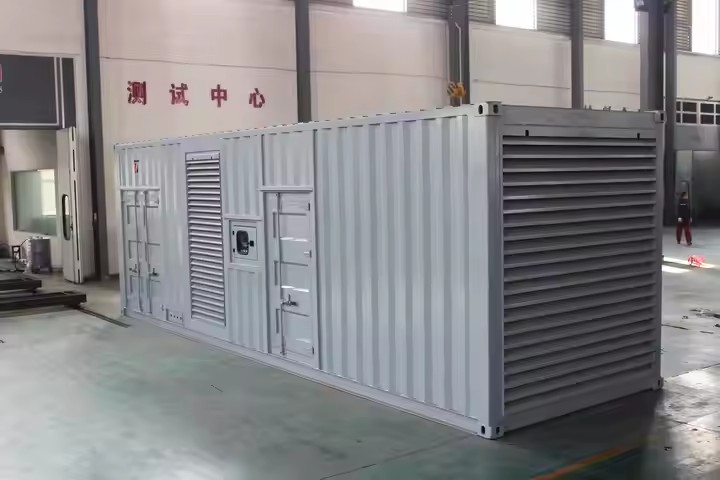
That gap is 120 mm: 2,697 mm at the load line minus 2,577 mm at the door head. Any skid, jacking frame or blocking that adds more than 120 mm above the set cannot be loaded through the door without tilting, and tilting a machine of this mass is a rigging decision, not a packing decision. Enclosure height therefore has to be confirmed against the door opening before the set is built, and that confirmation belongs in the order, not after the factory test.
Mass planning follows the same logic. The payload figure of 28,600 kg must cover the set, the base tank if integral, the lashing and the blocking, so the mass build-up before packing is a document to request with the quotation rather than with the shipping instructions. Where a set and its enclosure exceed one container, the build is normally split across two units and reassembled on site, which changes the installation scope.
Which performance class must the set hold?
The performance class states how the set behaves when the load steps, and it is separate from the rating. ISO 8528-5 groups generating sets into classes from G1 to G4 by their steady-state voltage and frequency behaviour and by their transient deviation and recovery time. A G1 class suits a general-purpose load; G3 and G4 apply where the load is sensitive to frequency and voltage excursions, such as a rectifier bank or a server hall.
The class is worth writing into the order because it changes hardware: the governing system, the excitation arrangement and the alternator reactances all move with it. Our 200 kVA sheet states it explicitly — ISO 8528 G3 compliant, steady-state frequency regulation of ±0.25 percent, total harmonic distortion below 2 percent at no load and below 5 percent on a balanced three-phase load. Those are the figures a class claim should be backed by, and Tesla Power Equipment publishes them rather than leaving the buyer to infer them. The ISO catalogue entry for 8528-5 defines the class boundaries.
A class claim without numbers is not a specification. When two suppliers both offer a 2,500 kVA set for sensitive loads, ask each for the transient deviation, the recovery time and the distortion limit at the stated load, then check the answers use the same class and power factor. The class letter is the summary; the numbers are the evidence.
What the service plan has to cover
Service planning for a machine of this size is about hours, not months. The same 200 kVA sheet states an oil change interval of up to 500 hours in normal duty, with spin-on oil, fuel and air filters that need no special tool, and an engine control module that holds fault codes and running history. Tesla Power sets the schedule from the hours a site declares. A set running 200 hours a year and a set running 4,000 hours a year need the same parts list and a different schedule.
Two items deserve a line in the contract. The first is the spares holding agreed at handover: filters, belts, a starter and a set of sensors are cheap at order time and slow to arrive later. The second is diagnostic access, because a controller that logs trends is only useful if the site team can read it. Where the machine is containerised, the plan also states how the doors are opened with the engine running. The generator specification notes cover the same points for smaller frames.
How a set above 375 kVA is classified for export
Diesel generating sets fall in heading 8502, and the subheading follows the output. Per the USITC Harmonized Tariff Schedule retrieved on 12 September 2026, 8502.11 covers sets not exceeding 75 kVA, 8502.12 covers sets above 75 kVA but not exceeding 375 kVA, and 8502.13 covers sets above 375 kVA. Every rating discussed here falls in 8502.13, and the same thresholds appear word for word in the UK and EU tariffs.
Classification is only the first step, because the duty rate depends on origin and on the measures in force at the time of import. The order documentation should state the classification, the origin, and the emission standard the engine is built to: for non-road engines sold in the EU that is Regulation (EU) 2016/1628, and for the United States it is the EPA Tier 4 programme. Neither statement is a claim about a specific shipment; both are fields the importer needs before the goods arrive. Confirm the rate against the importing country’s current tariff.
What to fix in the RFQ before the drawing is issued
The RFQ decides most of the cost, and it decides it before any supplier has drawn anything. Six fields do the work: duty rating and class, site voltage and frequency, enclosure type and noise limit at the stated distance, ambient temperature and altitude, fuel storage arrangement, and the documents required at handover. A seventh field, the access route, decides whether the enclosure is built to fit a container or to fit a door.
- Duty rating, power factor and performance class, stated together.
- Voltage, frequency and neutral arrangement at the point of connection.
- Enclosure type, noise limit and the distance it is measured at.
- Site ambient and altitude, because both reduce available output.
- Fuel tank arrangement, integral or separate, with the runtime target.
- Test record, drawing set and spares list required at handover.
Those six fields are what a manufacturer needs to price honestly, and they explain why two quotes for one rating differ widely. A quote that omits the enclosure, the breaker or the test record is a shorter scope, not a cheaper one.
For a build in this band, an existing frame one step down is the quickest way to sanity-check a figure: the KTA38 build at 1,000 kVA, 800 kW at 0.8 pf shows how the same documentation set looks at a lower rating. Tesla Power Equipment issues that drawing set on request.
Questions buyers ask in this rating band
Is 2,500 kVA the same as 2,000 kW at 0.8 pf?
Yes. The kVA figure is apparent power and the kW figure is real power: 2,500 kVA at 0.8 pf gives 2,000 kW. A set quoted at a different power factor delivers a different kW figure, so the power factor belongs in the order, not only in the brochure.
Can a set this size ship in one 40ft container?
Not always. A 40ft high-cube gives 12,032 mm of internal length, 2,697 mm of height to the load line and 28,600 kg of payload, per the carrier specifications retrieved on 12 September 2026. Whether one set fits depends on its enclosure height, mass and base tank, so the answer comes from the general arrangement drawing for that build.
What does the series name tell me before I see a data sheet?
It identifies the engine platform, not the rating. The rating comes from the duty statement plus the alternator and cooling package around that engine. Two sets on one platform can be rated differently because those parts were chosen differently, so the platform name is the start of the question rather than the answer.
Should the order specify ISO 8528-5 class G3 or G4?
The load list settles it. G3 suits most industrial standby work with motor starting and mixed loads; G4 is specified where the load cannot tolerate wider frequency or voltage excursions, such as a controlled rectifier or a data hall. Ask for transient deviation and recovery figures either way; the class letter alone does not fix them.
How long can the set run between oil changes?
The interval is set by the engine manual for that model and duty and is stated in hours rather than months. On the Tesla Power 200 kVA sheet the figure is up to 500 hours in normal duty. At 2,000 kW the sump volume and filter set are larger, and the schedule should follow the running hours the site expects.
Who confirms the emission standard for the destination?
The importer does, and the supplier states what the engine is built to. For non-road engines in the EU the reference is Regulation (EU) 2016/1628; in the United States it is the EPA Tier 4 programme. Neither applies automatically to every market, so the requirement belongs in the RFQ with the destination country named.
The decision that carries this band is the duty statement, not the platform name. Fix the rating, the class and the envelope in writing, ask for the numbers behind each claim, and send the load list with the destination port to the contact page for a frame review so the configuration is checked against the drawing before production starts.
Prepared by the export engineering desk at Yangzhou Tesla Power Equipment Co., Ltd., which builds sets from 25 kVA upward against a written duty statement.