
A diesel generator set license is a package of emission, noise and electrical approvals, not one permit; the documents required change with the install site. Which authority signs off depends on where the set runs, what it powers and who holds the operating permit. Across projects supplied by Yangzhou Tesla Power Equipment Co., Ltd. to factories, ports and clinics, the same pattern repeats: a set that clears customs can still be refused permission to run when its declared rating, sound level or engine tier does not match the application. This guide separates the approval package into the pieces authorities actually review — the engine emission tier, the noise label, the electrical and fire installation, the rating declaration and the shipping papers — and shows where each document originates. It includes a worked example for a 160 kW set at 0.8 pf, a document table you can copy into an application, and the mistakes that most often delay a decision. It also explains which rating belongs on the form and why a witnessed test report shortens an inspection. Compare your load list and site limits against the sections below, then request a diesel generator documentation checklist before you place the order.
- A diesel generator set license is assembled from separate emission, noise and electrical approvals.
- The engine tier and the declared rating decide which paperwork the authority asks to see.
- Noise limits are usually written at a 7 m measurement point, not at the enclosure wall.
- Permit files fail most often on mismatched power figures and missing test reports.
Reviewed by the engineering team at Tesla Power · Updated November 2026
What Does a Diesel Generator Set License Actually Cover?
A diesel generator set license is not one certificate but the sum of independent approvals that allow a set to run at a named site. Four recur in most markets: an engine-emission conformity document, a noise declaration, an electrical and fire installation approval, and commercial shipping papers. Each comes from a different authority and is checked against the same machine — engine model, rated output and enclosure. When those descriptions disagree, the application stalls.
The permit belongs to the installation, not the factory. A set that is legal to manufacture and export can still be refused if the site sits in a low-emission zone, near housing, or in a building without an engineered exhaust route. The first question is where it will run, for how many hours and on what fuel. Answering those points early lets a supplier issue a rating declaration that matches the permit, avoiding a redesign after delivery. Tesla Power issues one master data sheet so every derived document quotes the same figures.

Which Emission Documents Usually Decide Approval?
Engine-emission conformity is checked first because it is written into law, not left to the site. In the European Union, generating-set engines fall under Regulation (EU) 2016/1628, which sets Stage V limits and marking requirements. In the United States the reference is EPA Tier 4 Final for the engine family. The file should name the exact model, family and certified tier, and that wording must match the engine plate on the unit that arrives.
ISO 8528-1:2018 defines the duty terms — prime, standby, limited-time and continuous — that an authority uses to read a declared output. A permit allowing limited annual hours is usually written against standby duty; continuous duty needs different evidence. Our diesel generator emission paths reference sets out how regimes differ. Where an application crosses regimes, name both: a file giving the Stage V certificate and the corresponding EPA tier, each with its engine family, lets the reviewer verify the claim. Quote numbers from the certificate, not a summary.
How Is Generator Noise Measured for a Permit?
Noise approval is granted against an A-weighted level at a stated distance, commonly 7 m for generating sets. What matters is the level at 7 m under a defined load, not the loudest reading beside the enclosure. Authorities following the EU Outdoor Noise Directive framework also expect a sound power label, LWA. A data sheet quoting low noise without distance or load gives a reviewer nothing to check.
Test conditions matter as much as the number. A canopy set at no load reads differently from one at full load, and hard paving differs from an absorbing surface. Ask for distance, load percentage and mounting condition together, then check them against the site survey. Our generator noise limit guide explains the labelling. Where a site sits within 100 m of housing, an acoustic enclosure may be a permit condition and belongs in the quotation. Tesla Power records the 7 m figure with its load condition on every acoustic test sheet.

What Does NFPA 110 Require for Installation Approval?
For emergency and standby installations in the United States, NFPA 110 is the reference most inspectors work from. It classifies systems by type and level, which drive the run time, transfer switch location, fuel supply and separation of emergency distribution from normal wiring. A file stating only output, without the level and type, leaves the inspector to guess.
Local electrical codes differ, but the paperwork pattern is stable: a single-line diagram, a load schedule, an earthing arrangement and a statement of duty. Tesla Power’s engineering package supplies the diagram and load schedule together, because a reviewer reads them as one document. For a hospital or data room the inspector also wants evidence that the set starts and transfers within the demanded time, which is why a witnessed factory test report outweighs a brochure. Get the generator sizing calculation right first.
What Rating Declaration Do Authorities Expect?
Authorities expect a declared output with its unit, power factor and duty on the same line, because those three values define what the machine can deliver. A rating stated as 200 kVA at 0.8 pf means 160 kW of real power at the stated conditions; the same alternator described only as 200 kVA tells the reviewer nothing about engine loading. Keep the two units tied with the power factor in every sentence and table cell and the file will survive a technical read.
Prime, standby and limited-time on the application
Under ISO 8528-1 a standby rating covers variable load up to 200 h per year with no overload; a limited-time rating covers constant load up to 500 h per year. Prime allows variable load for unlimited hours and 10% overload for 1 h in 12 h. Each is testable, so a permit fixing annual hours effectively chooses the duty. Match the declaration to the permit wording.
Why the power factor belongs on the form
Omitting power factor invites two readings of one machine. A buyer may size a cable on 200 kVA at 0.8 pf while the air permit is written against a 160 kW engine; both are correct, but each belongs to a different check. Write the pair as 200 kVA at 0.8 pf equals 160 kW, repeat it on the nameplate, and the arithmetic is clear. That also stops a mixed-unit product slug being read as a second rating, which is why our 200 kW diesel generator set listing states one rating. Tesla Power repeats the value on the data sheet and nameplate.
How Do You Build a Permit File for a 160 kW Set?
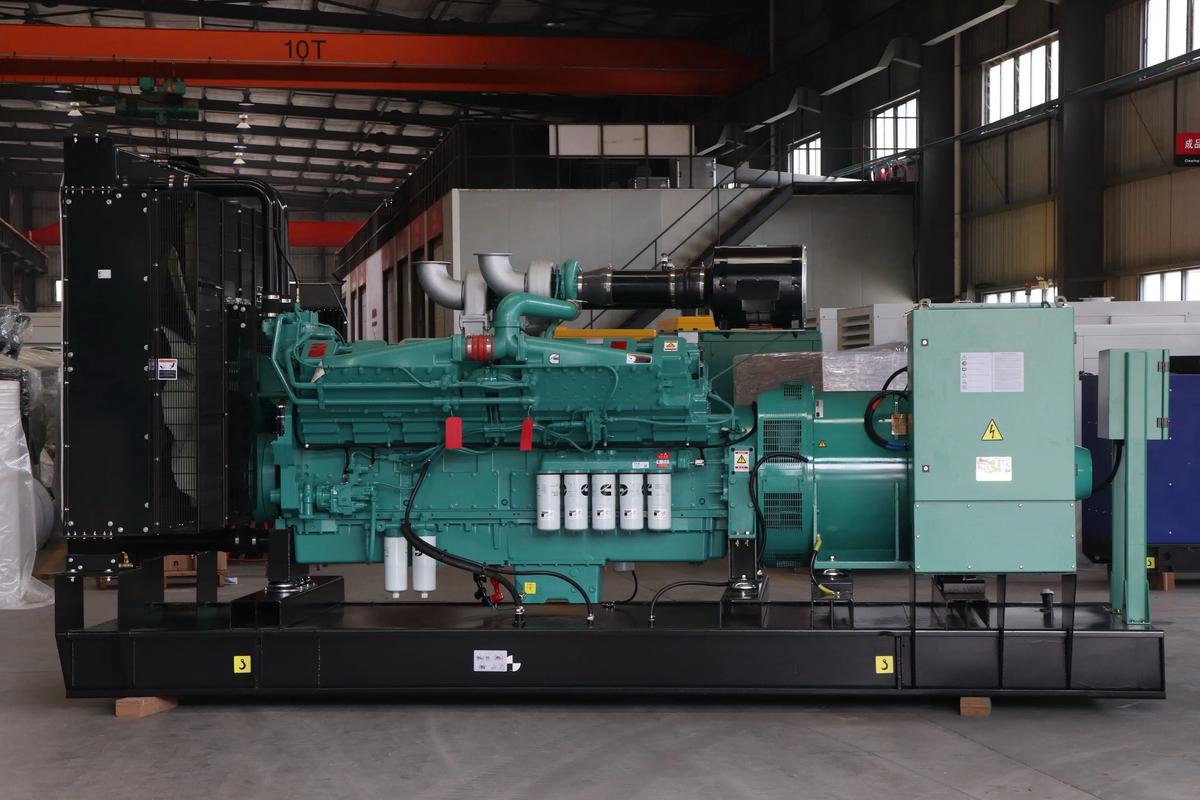
A permit file is an ordered set of documents in which every number points back to a certificate. The worked example uses a 160 kW prime set rated 200 kVA at 0.8 pf, from our internal specification sample for a Cummins QSL9-G5 engine. The arithmetic is short: 200 kVA at 0.8 pf equals 160 kW. If the air permit uses engine output, quote 160 kW; if the electrical permit uses alternator capacity, quote 200 kVA at 0.8 pf. They are one machine only because the power factor is stated. A set running 180 h per year also sits below the 200 h standby ceiling.
| Document | Where it originates | What the reviewer checks |
|---|---|---|
| Engine emission certificate | Engine family certification | Tier, family and model match the plate |
| Rating declaration | Manufacturer data sheet | kW, kVA and power factor stated together |
| Noise test evidence | Factory acoustic test | Level at 7 m with load and mounting stated |
| Single-line diagram | Project engineering pack | Transfer switch, earthing and load schedule |
| Factory test report | Witnessed load acceptance test | Start, transfer and steady-state figures recorded |
| Invoice and origin paper | Export documentation | Description agrees with the technical file |
Which Supporting Records Strengthen the File?
Supporting records show how the set was built and tested, not just how it was described. A factory test report recording start time, transfer behaviour and steady-state regulation is the most useful attachment in an installation permit file, because it answers the questions an inspector would otherwise ask on site. For the specification sample above, steady-state frequency regulation is ±0.25% and a service interval of 500 h is documented, both of which belong in the operations section. A supplier issuing one master data sheet and deriving every other document from it removes most inconsistency risk.
Service-life evidence is worth including where the permit is tied to a long operating licence. The same internal record gives an overhaul interval of 20,000 to 30,000 running hours under normal maintenance and notes compatibility with B20 biodiesel without modification. Where a site plans to run on a blend, stating that compatibility avoids a later variation request. Our generator origin certificate guide shows how the commercial papers should agree with the technical file.
What Mistakes Hold Up a Permit Most Often?
Most delays come from small inconsistencies rather than a missing certificate. The following failures recur when a set has cleared production but not yet been accepted at site:
- Two ratings on one file. The data sheet says 200 kVA at 0.8 pf while the application quotes only 160 kW, with no line connecting them.
- A noise figure without a distance. A bare decibel number is not checkable; a figure at 7 m under full load is.
- The wrong duty. A set declared for standby is described as continuous in the fire application.
- An engine tier that does not match the plate. The certificate names a family different from the engine delivered.
- Service evidence left out. No test report, no stated intervals, no statement of the fuel the set can burn.
Each is fixed at the quotation stage and expensive to fix at the port. Ask for the master data sheet before the order is placed and check that its numbers are the numbers on the application. A smaller 60 kW diesel generator set is reviewed by the same rules as a large one. Our generator pre-shipment inspection checks catch mismatches before loading. Tesla Power applies the same document set from the smallest unit to the largest plant.
Frequently Asked Questions
Is there one international diesel generator set license?
No. Approval is assembled from separate emission, noise, electrical and commercial documents, each issued under the destination market’s rules. The phrase describes the package, not a single certificate, so asking for the license by name produces no document. Ask for the emission, noise and installation file for the named site, and confirm which authority signs each part.
Which rating should I put on a permit application?
Put the rating the permit is written against, with its unit and power factor. If the air permit uses engine output, quote 160 kW; if the electrical permit uses alternator capacity, quote 200 kVA at 0.8 pf for the same set. Never write the two figures without the power factor, because a reviewer cannot tell they describe one machine.
Does a standby rating allow unlimited running?
No. Under ISO 8528-1 a standby rating is for variable load up to 200 h per year with no overload, and a limited-time rating covers constant load up to 500 h per year. If the site needs unlimited hours, the application should reference a prime rating instead. Choose the duty from the actual running pattern before the file is written.
How is the noise limit on a permit measured?
It is normally an A-weighted level at a stated distance and load, commonly 7 m at full load. Always ask for the distance, load percentage and mounting condition together, because a single figure without them cannot be verified. A reading at the enclosure wall is not comparable with one at 7 m, even for the same set.
Will a Stage V set be accepted in the United States?
Stage V and EPA Tier 4 Final are separate regimes, and holding one does not automatically satisfy the other. A file naming both the Stage V certificate and the corresponding EPA tier for the same engine family gives the reviewer a route to verify compliance in either market. Quote the certificate numbers rather than describing the standard in general terms.
What test evidence should accompany the application?
Include a witnessed factory test report with start time, transfer behaviour and steady-state figures, plus the engine emission certificate and the acoustic test at 7 m. Three documents that agree with each other are more useful than a larger bundle of summaries. Confirm that model numbers and ratings are identical across all three before submission.
Can the permit be arranged after the set ships?
It can, but it is risky. A mismatch between the delivered engine tier, the declared rating or the noise label can hold a container at the port while a corrected sheet is issued. Assemble the file from the master data sheet before shipment and verify every number against the unit loaded. That check takes hours at the factory and weeks at a destination port.
Final Checks Before You Order
A diesel generator set license is won or lost on consistency: one master data sheet, one declared rating with its power factor, one engine tier matching the plate, and one noise figure measured at a stated distance. Get those four right and the remaining paperwork follows; get any wrong and a technically perfect set still cannot run at the site it was bought for. Request the documentation package for your destination and duty cycle now, and have it reviewed against your site limits before the order is confirmed. Request a generator documentation checklist and Tesla Power will issue the master sheet and supporting test evidence together, so the file you submit is the same file we build to.